Artificial intelligence is entering clinical trial recruitment quickly. Research organizations are exploring it for participant matching, preliminary pre-screening, lead prioritization, communication, data review, routing, workflow automation, and recruitment analytics. The potential is real. So are the limits.
The useful question is not “Should we use AI in recruitment?” The better question is “Which recruitment tasks can AI improve without creating new risks or replacing decisions that still require human judgment?” That distinction matters because clinical research recruitment is not only a data problem. It is also a communication problem, a trust problem, an operational problem, a participant-experience problem, and sometimes a clinical interpretation problem. AI can help with several of those areas. It should not be expected to solve all of them.
AI Is Best at Structure, Scale, and Pattern Recognition
AI is particularly useful when a recruitment task involves large volumes of information, repetitive review, pattern recognition, classification, prioritization, summarization, or administrative automation. Consider a recruitment team that receives 500 participant inquiries. AI can potentially help categorize responses, detect incomplete information, identify likely duplicates, prioritize records for human review, summarize participant notes, or suggest routing. That can reduce manual workload. But prioritization is not the same as final eligibility.
AI Can Support Trial Matching
One of the most promising applications is matching potential participants to clinical trials. AI can help compare participant characteristics, diagnosis, treatment history, location, and trial criteria — and in complex therapeutic areas, that can save significant time.
A 2026 scoping review and meta-analysis of AI in clinical trial participant recruitment and retention, published in the Journal of Clinical and Translational Science and covering 121 studies, found strong performance in several areas including screening, eligibility identification, and classification, although performance varied across applications (PubMed). That suggests AI can be valuable as a decision-support layer — not necessarily as the final authority.
AI Can Help With Preliminary Pre-Screening
Preliminary pre-screening is another natural area. AI may help organize participant responses and identify obvious high-level mismatches, missing information, ambiguous responses, and cases that require human review.
Suppose a participant reports an age of 72 and the Study’s preliminary range is 18–65. A rules-based system can identify that mismatch easily. AI becomes more useful when responses are less structured — for example, “My doctor said I have something similar, but I’m not sure of the exact diagnosis.” Instead of forcing a binary yes/no decision, AI can flag the case as Needs Human Review. That is a stronger use case.
AI Can Prioritize, Not Diagnose
This principle should remain clear. AI may help answer “Which cases deserve closer review?” It should not automatically answer “Which participant definitively qualifies?” Formal Study eligibility may require medical history, medication review, laboratory tests, medical records, investigator judgment, and protocol-specific procedures. Recruitment technology should respect that boundary.
AI Can Summarize Participant Information
Recruiters often need to review form responses, call notes, prior messages, and pre-screen answers. AI can condense that into a concise summary — for example: “Participant age 58, located 14 miles from Site, Spanish preferred, reports confirmed diagnosis, completed pre-screen, unclear medication history.” That helps a recruiter prepare for the next conversation. It saves time without replacing the conversation.
AI Can Support Multilingual Recruitment
AI can assist with first-draft translation, terminology comparison, bilingual response templates, localization review support, and language classification, which can accelerate bilingual workflows. But AI translation should not become the final participant-facing review. Clinical research language requires accuracy, context, natural tone, and regulatory consistency, and human review remains valuable.
AI Can Improve Recruitment Routing
In multi-Site Studies, AI can help evaluate geography, Site capacity, language, participant preference, current enrollment, and travel time. A participant does not automatically need the nearest Site — the better routing decision may depend on several variables, and AI can help rank the options.
For example, Site A may be 12 miles away with a three-week screening backlog, while Site B is 18 miles away with same-week availability. The system might flag Site B as the better operational option. That is useful decision support.
AI Can Help Detect Duplicates and Anomalies
Digital recruitment generates noise: duplicate submissions, suspicious patterns, bot activity, and invalid contact information. AI and automated detection tools can help identify unusual patterns and protect recruiter time. The objective is not perfect automatic rejection. It is intelligent flagging.
AI Can Help With Recruitment Analytics
Recruitment generates large amounts of data, and AI can assist in identifying weak funnel stages, geographic patterns, language differences, Site performance, referral quality trends, and creative performance. The system might detect that a Spanish campaign has a higher cost per lead but stronger referral-to-screening conversion, or that Site C receives many referrals but its response time is slowing. Insights like these help teams act faster.
AI Can Support Forecasting
As recruitment data accumulates, AI may help estimate expected enrollment pace, likely Site bottlenecks, budget needs, and geographic opportunity. Forecasting can help answer whether the Study is on track, which Site may need additional volume, and where budget should shift. These models are only as good as the data supporting them — poor data produces poor forecasts.
AI Can Help Recruiters Prepare Better
AI does not need to speak directly to participants to be valuable. Behind the scenes, it can help recruiters summarize notes, identify next actions, prepare follow-up, surface unresolved questions, and organize participant history. This may be one of the safest and most useful early applications.
Where AI Should Not Replace Humans
There are several areas where human involvement remains critical.
1. Complex participant questions. Participants may ask whether a Study will affect their medication, what happens if they experience symptoms, whether they should participate, whether the investigational product is safe, or whether their doctor can advise them. These are not generic workflow questions. They may require trained research personnel, clinical knowledge, and appropriate escalation. AI should not independently provide medical advice.
2. Formal eligibility determination. Final protocol eligibility should not be delegated casually to AI. Even when AI tools assist screening, qualified research personnel remain responsible for the Study process. AI can support review, but it should not automatically become the clinical decision-maker.
3. Informed consent discussions. Informed consent requires more than delivering information. Participants must have the opportunity to ask questions, understand uncertainty, discuss risks, understand alternatives, and make a voluntary decision. FDA informed-consent guidance states that a person knowledgeable about the clinical investigation and capable of answering questions raised by the prospective subject should conduct the consent discussion (FDA). AI may support educational material, but it should not casually replace the human responsibility built into the consent process.
4. Emotional or sensitive conversations. Clinical research can involve serious illness, pediatric conditions, Alzheimer’s disease, cancer, caregiver burden, and uncertainty. Participants may need empathy. AI can simulate polite language, but that is not the same thing as human understanding. For sensitive situations, human communication remains essential.
5. Ambiguous pre-screening. Some answers do not fit clean categories. “I stopped the medication recently but don’t remember exactly when” may or may not matter, depending on the protocol. AI can flag the answer. A human should review it.
6. Participant trust. People may ask, “Am I speaking with a real person?” That question matters. If AI is used in participant communication, transparency is important, and research organizations should avoid creating false impressions. A participant should not reasonably believe they are speaking with a physician, coordinator, or investigator when the interaction is actually automated.
AI Should Not Pretend to Be a Research Professional
This is one of the clearest boundaries. An AI system should not falsely present itself as an investigator, physician, research coordinator, or nurse. That can undermine trust. Technology should identify its role appropriately.
AI Should Not Overstate Study Information
Generative AI can produce confident language even when information is incomplete, and that creates risk. Participant-facing AI should not invent eligibility criteria, Study benefits, risk information, compensation, visit requirements, or medication guidance. Responses should be grounded in approved Study information.
Guardrails Matter
A participant-facing AI system should have clear limits. It can explain next steps, provide approved logistics, confirm receipt, and answer basic workflow questions. It should escalate medical questions, eligibility uncertainty, safety concerns, consent questions, and participant distress. That is much safer than unrestricted conversation.
AI Should Know When to Stop
One of the most important AI functions is escalation. A good system should recognize “This requires a human” — for example, with an unclear diagnosis, a medication question, a potential safety concern, an emotional participant, contradictory responses, or a language misunderstanding. Automation should not push the participant deeper into a flow when context becomes uncertain.
The Best Model Is Human-in-the-Loop
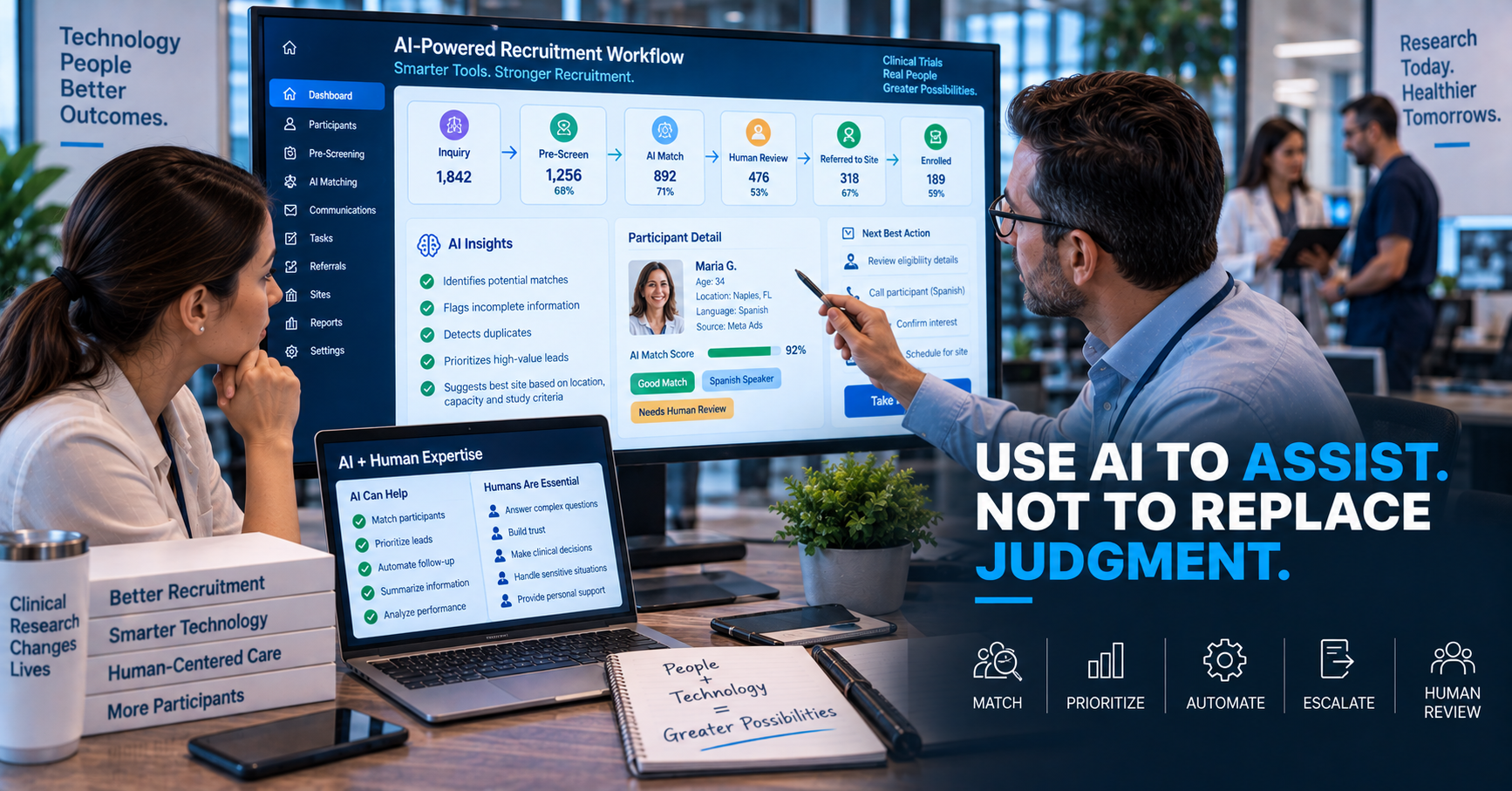
For many recruitment workflows, the strongest model is AI assistance plus human review. AI organizes responses; a human reviews the exceptions. AI suggests the next step; a human makes the judgment. AI routes the referral; a human conducts the Study-specific interaction. This preserves both efficiency and accountability.
Human-in-the-Loop Does Not Mean Human Approval of Everything
That would eliminate much of the value. Routine administrative tasks — confirmations, reminders, status updates, routing, and scheduling — can remain automated. Human review should be concentrated where judgment matters.
AI Can Help After Hours
AI-assisted systems can support recruitment when Sites are closed. If a participant registers at 11:30 PM, the system can confirm registration, provide approved information, collect basic preliminary questions, identify a preferred contact time, and flag the case for recruiter follow-up. That creates continuity without requiring AI to make clinical decisions.
AI Can Improve Recruiter Productivity
Suppose a recruiter handles 80 participant records. AI can help identify overdue follow-ups, incomplete forms, high-priority participants, and referrals awaiting Site action. Instead of reviewing every record manually, the recruiter can focus attention where it matters. That is practical value.
AI Should Support Participant Experience
Automation is valuable only if it improves the journey. Bad AI can create confusing responses, repetitive questions, cold interactions, the wrong language, and false certainty. The participant experience should remain clear, respectful, transparent, and easy to navigate. Technology should reduce friction.
Measure AI Performance
Organizations should not assume AI is improving recruitment. Measure it. Useful metrics include response time, pre-screen completion, recruiter workload, escalation rate, referral rate, participant drop-off, error rate, and Site screening conversion. Compare the numbers before AI with the numbers after. Technology should earn its role.
Monitor False Positives and False Negatives
AI can make mistakes in two directions. A false positive flags someone as potentially relevant when they are not, which means more Site burden. A false negative dismisses someone who should have been reviewed, which means a lost recruitment opportunity. False negatives can be especially problematic, which is why borderline cases should often move to human review.
Bias Needs Attention
AI models can reflect bias in training data, historical Site data, healthcare records, and recruitment patterns. If historical recruitment underrepresented certain populations, a model trained blindly on past outcomes could reproduce that pattern. Organizations should evaluate whether AI decisions create systematic differences across age, language, geography, and demographic groups.
Data Quality Matters
AI cannot fix unreliable recruitment data automatically. If Site statuses such as “qualified,” “screened,” “accepted,” and “referred” have unclear definitions, the AI will learn from messy inputs. Before advanced AI, organizations often need clean workflows and standardized data.
Privacy and Data Governance Matter
AI may process sensitive participant information. Organizations should understand what data the AI receives, where it is processed, who can access it, whether third-party providers are involved, and how retention, security, and reuse are handled. Do not feed sensitive participant information into systems without understanding the data flow.
AI Governance Should Be Practical
Organizations do not need a 200-page AI policy before using any automation, but they should be able to answer a handful of practical questions. Purpose: why are we using AI? Scope: which tasks can it perform? Data: what information can it access? Escalation: when does a human intervene? Oversight: who reviews performance? Participant transparency: what should participants know? That is a practical starting point.
AI Should Be Study-Aware
Generic AI knows general information. Recruitment AI needs Study-specific boundaries. It should operate from approved recruitment materials, Study-specific FAQs, workflow rules, and approved participant communication. The more participant-facing the system is, the more important controlled knowledge becomes.
Generic Chatbots Are Not Enough
A general chatbot may be able to answer “Tell me about clinical trials.” A recruitment assistant should understand this Study, this Site, this workflow, and this participant stage. Context matters.
AI Can Help Sites Learn
Over time, AI can identify recurring patterns: most drop-offs occur after question 6, weekend leads get weaker follow-up, Spanish-speaking participants prefer SMS before phone contact, one geography produces high screen failure, or one Site consistently delays referrals. These insights can guide operational improvement.
AI Should Not Become the Strategy
This is another common mistake. Organizations sometimes begin with “We need AI.” The correct sequence is to ask what problem they are trying to solve, and then whether AI is the best tool. If the problem is that participants receive no acknowledgment after hours, simple automation is enough. If the problem is that manual review of complex participant histories takes hours, AI may add significant value. Use the simplest technology that solves the problem.
AI and Automation Are Not the Same Thing
The distinction is useful. Automation follows a rule: if X happens, do Y — for example, form completed, send confirmation. AI interprets less structured information — for example, reviewing participant responses and flagging which cases need human clarification. Both are valuable. Do not add AI where rules are sufficient.
A Practical AI Recruitment Framework
A balanced model separates three kinds of work. Automate confirmations, reminders, task creation, basic routing, and status updates. Use AI assistance for summarization, matching, prioritization, classification, anomaly detection, and analytics. Keep humans central for complex participant questions, ambiguity, medical interpretation, formal eligibility, consent, and trust-sensitive interactions.
The Future Is Assisted Recruitment
The future of clinical trial recruitment is probably not human or AI. It is human plus AI plus automation, with each performing a different function. AI provides scale. Automation provides consistency. Humans provide judgment. Research Sites that understand that distinction can use technology aggressively without losing the human qualities clinical research still depends on.
AI Should Make Humans Better at Recruitment
That may be the best test. If AI means recruiters spend less time copying data, repeating review, searching records, and handling administrative follow-up — and more time on participant questions, trust, complex review, and Site coordination — then AI is helping. If it simply adds another dashboard, another chatbot, or another source of confusion, it is not.
The Right Question
Do not ask “How much of recruitment can we replace with AI?” Ask “Where can AI remove unnecessary work while preserving the human judgment and trust the participant journey still needs?” That question leads to better technology decisions.
Related Reading
- From Lead Generation to Preliminary Pre-Screening: The Evolution of Clinical Research Recruitment
- Human Follow-Up vs Automation in Clinical Research Recruitment
- What Is a Pre-Screened Participant Referral?
- CRM for Clinical Trial Recruitment: What Research Sites Actually Need
- Why Participant Experience Matters Before the First Research Site Call
Frequently Asked Questions
Can AI be used for clinical trial recruitment?
Yes. AI can assist with participant matching, pre-screening support, prioritization, summarization, routing, analytics, and other recruitment tasks.
Can AI determine final Study eligibility?
AI may assist eligibility review, but final protocol-based screening should remain within the appropriate Study process and qualified human oversight.
Should AI communicate directly with participants?
It can support certain participant-facing tasks, such as approved workflow information or administrative questions, but organizations should use clear guardrails and human escalation for medical, sensitive, or ambiguous issues.
Is AI the same as recruitment automation?
No. Automation follows predefined rules. AI can interpret more complex or unstructured information. Many recruitment tasks only require automation.
What is the best use of AI in participant recruitment?
High-value uses often include summarization, prioritization, trial matching, identifying cases for review, and helping staff focus on the participant interactions where human judgment matters most.