
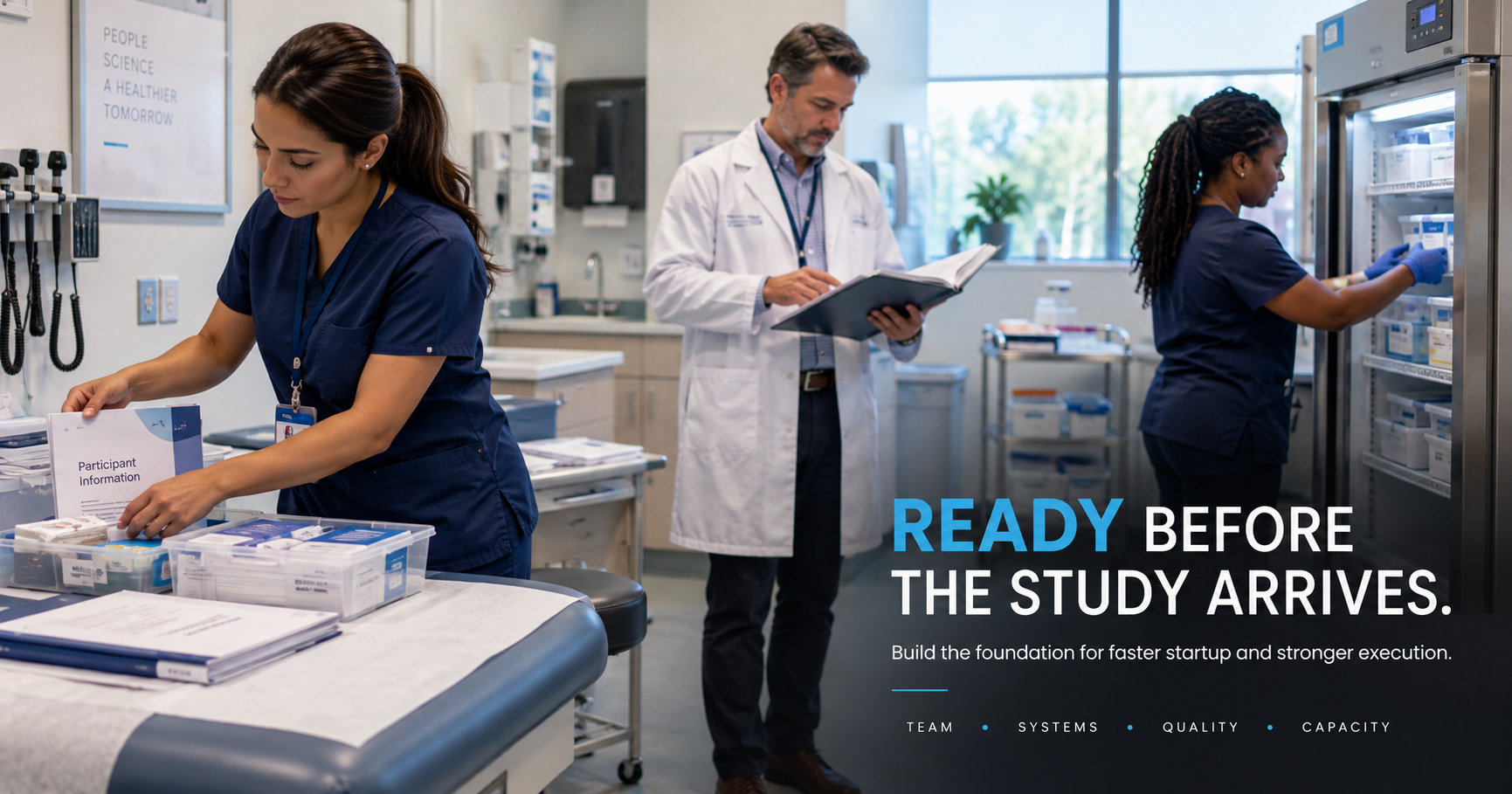
A Clinical Research Site should not begin preparing for operational readiness only after receiving a Study opportunity. By then, the clock is already running. The CRO may be requesting feasibility information, investigator documents, equipment details, recruitment estimates, staffing information, and startup timelines. A Site that must build everything from scratch every time loses speed.
A stronger Site maintains a baseline level of readiness continuously. That means being able to answer a handful of practical questions: who will run the Study, where will procedures happen, how will participants be recruited, how will data be handled, how will quality be maintained, and how will participants be protected? Site readiness is not one checklist. It is an operating system.
What Is Clinical Trial Site Readiness?
Site readiness is the ability of a Research Site to conduct a clinical trial reliably from startup through closeout. A 2023 framework published in the Journal of Clinical and Translational Science was developed from 217 site qualifications extracted from 50 documents used to assess, monitor, and audit US-based clinical trial sites, collected from 14 research sponsors that included pharmaceutical companies, CROs, government agencies, and an academic institution. It groups readiness into six domains (Journal of Clinical and Translational Science, 2023):
- Research team
- Infrastructure
- Study management
- Data collection and management
- Quality oversight
- Ethics and safety
These areas describe much more than simply having an investigator and an exam room. They reflect the full operational foundation required to execute research consistently.
Readiness Should Exist Before Feasibility
Many Sites become reactive. The pattern looks like this: a Study opportunity arrives, the team searches for documents, updates CVs, checks equipment, asks who is available, builds a recruitment estimate, and rushes the feasibility submission. That approach creates avoidable friction. A ready Site already knows most of those answers.
Readiness Has Three Foundational Principles
The same framework identifies three principles that cut across all Site readiness practices: a culture of quality, clinical research literacy, and person-centeredness. These principles matter because readiness is not just about having systems. It is about how the organization uses them. A Site can own excellent technology and still have poor workflows. A Site can have experienced staff and still lack accountability. Readiness is partly infrastructure. It is also culture.
1. Research Team Readiness
A Study needs more than a PI. A ready Site has sufficient people with clear roles. Potential team members include the Principal Investigator, Sub-Investigators, Clinical Research Coordinators, Research Nurses, regulatory staff, recruitment staff, pharmacists, laboratory staff, data personnel, and quality personnel. The framework describes research team members who are qualified through experience, training, and mentorship, and who receive initial and refresher training to perform clinical trial activities per ICH GCP standards.
Qualified Does Not Mean Available
A Site may have five excellent coordinators, but all five may already be overloaded. Readiness requires capability plus capacity. Leadership should know the active Study load, screening volume, expected new Studies, and staff availability. A Study should not be accepted simply because someone technically has the credentials.
Maintain Training Readiness
Teams should maintain relevant GCP training, role-specific training, professional credentials, and Study-related certifications where applicable. Do not wait until startup to discover that important training has expired.
Investigator Readiness
The PI should be prepared not only clinically but operationally. That includes adequate research experience or support, availability, protocol engagement, and oversight capacity. A strong Site can quickly confirm: this investigator is interested, qualified, and has enough capacity to support the Study.
2. Infrastructure Readiness
Infrastructure includes more than physical space. The framework defines it broadly as the physical and operational software, systems, policies, and facilities a PI and research team need to conduct research, including interoperable information systems, equipment, supply management, human resource management, talent development, administrative, financial, and legal functions, and business continuity planning (Journal of Clinical and Translational Science, 2023). A Site should understand exactly what it can support.
Physical Space
Depending on the Site, this may include exam rooms, participant waiting areas, private consent space, laboratory processing areas, a pharmacy, and secure storage. The Site should know availability, capacity, and privacy limitations.
Equipment
Maintain an updated list of equipment such as ECG, centrifuge, refrigerator and freezer, temperature monitoring, infusion equipment, scales, and vital-sign equipment. Calibration and maintenance should be organized. A Site should not discover missing calibration records during startup.
Communications Infrastructure
Basic reliability matters too. The framework specifically includes providing reliable physical and operational infrastructure, such as electric power, internet access, and telephone service. Operational continuity depends on these basics.
Business Continuity
Ask what happens if something fails: a power outage, a freezer failure, an internet outage, or staff absence. A Site should have realistic contingencies.
3. Study Management Readiness
Every Study introduces timelines, responsibilities, vendors, visits, training, and documentation. A ready Site has a repeatable Study-management process: Award → Startup → Training → Recruitment → Visits → Monitoring → Closeout. The protocol changes. The internal process should remain organized.
Define Ownership
Every major activity should have an owner. The regulatory lead owns startup. The recruitment coordinator owns recruitment. An assigned CRC owns participant visits. The Site Director or Study lead owns Sponsor communication. The coordinator or data team owns data. Ambiguous ownership creates delay.
Use Startup Checklists
A Site should know what must happen before activation: regulatory documents, contracts, budget, investigator documents, Site training, equipment readiness, recruitment materials, and systems access. A standardized startup checklist can reduce omissions.
4. Data Collection and Management Readiness
A Research Site exists partly to produce reliable Study data, so data management should not be an afterthought. The framework includes practices such as implementing controls for systems that process study data (including audits, system validations, and audit trails), collecting, accessing, and exchanging data in a timely, accurate, and complete manner, ensuring monitors, Sponsor personnel, and regulatory authorities have access to source material, and ensuring quality control of data and source documentation (Journal of Clinical and Translational Science, 2023).
Know the Source Workflow
The Site should understand where source data lives, who enters data, when data is entered, how corrections occur, and how monitors access records. Fragmented data workflows create unnecessary risk.
Data Timeliness Matters
A ready Site should monitor data-entry lag, open queries, and unresolved discrepancies. Strong data practices improve Sponsor confidence.
System Access Should Be Organized
Startup often requires access to multiple systems: EDC, IXRS/IRT, ePRO, Sponsor portals, and laboratory portals. Track who needs access, whether training is complete, and whether credentials work. Do not let basic login problems delay execution.
5. Quality Oversight Readiness
Quality should not begin when a monitor finds an issue. The framework describes a culture of quality as establishing processes designed for error prevention, and requires that Sites can measure errors, identify root causes, and apply process improvements for continuous improvement. Strong Sites build quality into daily operations.
Use Internal Quality Checks
Possible checks include consent documentation, eligibility documentation, protocol-required procedures, visit completeness, source documentation, and investigational product accountability. Not every Study needs the same checklist, but quality oversight should be systematic.
Track Deviations
Do not treat deviations only as reporting events. Analyze patterns. Ask why it happened, and whether the workflow could be improved. Repeated issues often signal a process problem.
Corrective Action Should Change the System
A weak response is “Staff reminded.” A stronger response might involve a workflow change, a checklist, training, an ownership change, or a system alert. Quality improvement should reduce recurrence.
6. Ethics and Safety Readiness
Participant protection is central to Site readiness. The framework includes the ability to execute an informed consent or assent process that is respectful of participants, to maintain confidentiality while promoting transparency and trust about how data will be used, to report to a properly constituted IRB or ethics committee, to identify, assess, process, and report safety events, and to communicate study risks and benefits in a manner that is accessible and culturally and linguistically appropriate (Journal of Clinical and Translational Science, 2023). This is not simply a regulatory requirement. It affects participant trust.
Consent Readiness
The Site should have people capable of conducting appropriate consent discussions. That means time, privacy, training, and participant-friendly communication. Consent should not become signature collection.
Safety Reporting
Sites need clear processes for recognizing events, escalation, documentation, and Sponsor reporting. Staff should know who gets called and when.
Confidentiality
Participant data should have appropriate controls, including physical records, electronic systems, recruitment systems, and communications.
Language and Accessibility
Participant protection also includes understandable communication. If the Site recruits Spanish-speaking participants, it should be prepared to support Spanish communication, appropriate materials, and bilingual staff or workflows. Accessibility should exist throughout the Study.
Recruitment Readiness Deserves Its Own Attention
Recruitment is embedded across the larger readiness system, but operationally, it deserves specific planning. Before the Study arrives, ask: do we have recruitment staff, CRM capability, the ability to launch digital campaigns, bilingual recruitment, pre-screening, and referral tracking? A Site that waits until enrollment falls behind is already reacting.
Recruitment Materials Workflow
Our guide to preparing recruitment materials for IRB review covered the review process for recruitment materials. A ready Site should already have a workflow for it: Study Review → Creative Development → IRB Submission → Platform Review → Campaign Launch. This reduces launch delays.
Participant Communication Readiness
Define confirmation messages, follow-up workflows, after-hours handling, contact attempts, and preferred language. Participant communication should not be improvised Study by Study.
Technology Readiness
Technology should support recruitment, Study operations, communication, and reporting. A Site should know which systems it already has and which integrations may be required. The goal is not maximum software. It is operational readiness.
Financial Readiness
Clinical trials also create business obligations. The Site should understand budget review, contracts, payment terms, pass-through expenses, invoicing, and recruitment costs. A Site can perform clinically and still struggle financially if these systems are weak.
Legal and Contract Readiness
Contract negotiation can delay activation. Maintain authorized signatories, legal contacts, insurance documentation, and a contracting workflow. Every avoidable delay affects startup speed.
Feasibility Readiness
Our article on feasibility strategy for independent Research Sites covered feasibility in depth. A ready Site already maintains its Site profile, investigator information, patient population, equipment, historical enrollment, and recruitment capabilities. That makes feasibility faster and more accurate.
Sponsor/CRO Communication Readiness
A Site should not depend on whoever sees the email first. Define communication ownership. For each Study, name a primary contact, a backup contact, and an escalation path. Consistency makes the Site easier to work with.
Participant Capacity Readiness
A Study opportunity should be matched against actual capacity. Ask how many screenings the Site can support per week, how many participants staff can manage, whether exam rooms are available, and whether the PI is available. Readiness includes knowing when to say “not yet.”
A Ready Site Has an Updated Site Profile
Maintain one internal source containing investigators, staff, therapeutic areas, locations, equipment, recruitment, technology, and historical performance. This prevents inconsistent answers across the website, capabilities deck, feasibility responses, and Sponsor conversations.
A Ready Site Has Documentation Organized
Sponsors often request information quickly: CVs, licenses, GCP certificates, equipment calibration, and Site information. Maintain them proactively. Do not start searching after the request arrives.
A Ready Site Knows Its Own Performance
Readiness also means knowing enrollment history, recruitment velocity, retention, response time, and feasibility conversion. These metrics support both operations and business development — and our article on what makes a high-performing Clinical Research Site covers how to measure them.
Build a Site Readiness Dashboard
A simple internal dashboard might cover team (capacity and training), infrastructure (equipment and maintenance), Studies (active workload), recruitment (current volume and capacity), quality (open issues and deviations), and feasibility (pipeline and opportunities). This does not need to be complicated. The objective is visibility.
Readiness Is Continuous
A common mistake is treating Site readiness as something achieved once. It is not. Staff change. Equipment changes. Studies activate. Capacity changes. Training expires. Readiness should be reviewed regularly.
Use Quarterly Readiness Reviews
For example, each quarter ask: any staffing gaps? Anything expired or overdue in equipment? Can the Site handle another Study? Any recurring quality issues? Any technology workflow problems? What Studies are coming? This keeps readiness connected to growth.
Do Not Accept Growth Faster Than Readiness
Business development may successfully bring more opportunities. That is positive. But if Study growth exceeds readiness, quality falls, staff overload increases, and recruitment slows. Growth should be supported by operational capacity — our article on how to grow an independent Clinical Research Site covers how to keep growth balanced.
Readiness Can Become a Commercial Advantage
The readiness framework’s authors note that potential trial sites are burdened by having to repeatedly define quality and determine how best to demonstrate site readiness across different sponsors and studies, and they offer the framework as a harmonized template for sponsors and sites (Journal of Clinical and Translational Science, 2023). For a Site, that suggests a practical conclusion: readiness documentation kept in one place can be reused across Sponsors, which makes the Site easier to evaluate. Readiness is not only internal operations. It can support Site positioning, and it is a large part of what Sponsors weigh during selection, as covered in our guide to what Sponsors and CROs look for in a Research Site.
Show Readiness Through Evidence
Instead of saying “We are ready,” demonstrate a trained team, organized infrastructure, recruitment systems, historical performance, and quality processes. Readiness becomes credible when it is visible.
A Practical Site Readiness Checklist
Before pursuing the next Study, ask:
- Research team: Qualified PI? Enough coordinator capacity? Training current? Roles defined?
- Infrastructure: Space available? Equipment ready? Calibration current? Systems reliable?
- Study management: Startup process defined? Responsibilities assigned? Documentation organized?
- Data: Source workflow clear? Data-entry process defined? Quality control in place?
- Quality: SOPs current? Deviation management organized? Internal review process available?
- Ethics and safety: Consent workflow ready? Safety escalation clear? Confidentiality protected? Language support available?
- Recruitment: Participant sources identified? CRM ready? Follow-up workflow defined? Capacity available?
- Business: Feasibility data current? Contracts organized? Budget process clear?
If several answers are no, the Site may not need another Study yet. It may need stronger readiness first.
Readiness Reduces Friction
A ready Site can move through Opportunity → Feasibility → Startup → Recruitment → Execution with fewer avoidable delays. That benefits the Site, the Sponsor, the CRO, and participants.
Site Readiness Is the Foundation of Performance
The relationship is simple: readiness creates reliable execution, which creates performance, which creates Sponsor confidence, which creates more opportunities. That is why Site readiness should not be viewed as administrative preparation. It is growth infrastructure.
Related Reading
- Feasibility Strategy for Independent Research Sites: How to Give Sponsors Better Answers, Faster
- What Sponsors and CROs Look for in a Research Site Before Selection
- What Makes a High-Performing Clinical Research Site?
- How to Grow an Independent Clinical Research Site
- How to Measure Recruitment Performance by Research Site
Frequently Asked Questions
What is clinical trial Site readiness?
Site readiness is the ability of a Research Site to conduct clinical trials reliably across research team, infrastructure, Study management, data management, quality oversight, and participant ethics and safety.
What are the main Site readiness domains?
A published Site Readiness framework identifies six domains: Research Team, Infrastructure, Study Management, Data Collection & Management, Quality Oversight, and Ethics & Safety.
Should Research Sites assess readiness before feasibility?
Yes. Maintaining evergreen Site information and operational readiness can improve feasibility response speed and reduce startup delays.
Is recruitment part of Site readiness?
Yes. Sites should be prepared to identify, engage, pre-screen, communicate with, and track prospective participants before recruitment pressure begins.
How often should Site readiness be reviewed?
There is no universal cadence, but regular internal reviews are useful because staffing, Study workload, equipment, training, and capacity change over time.