
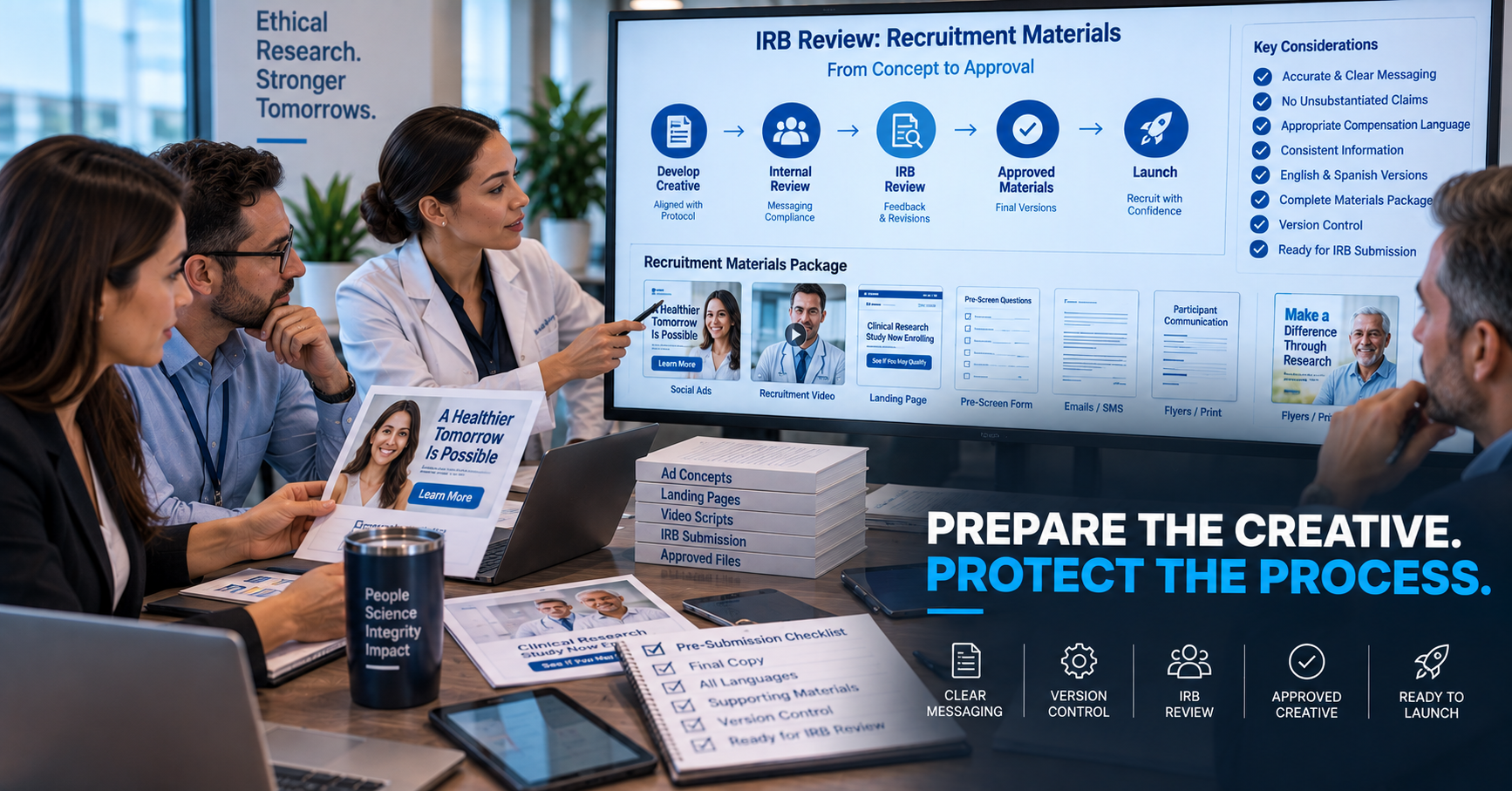
A clinical trial recruitment campaign can be strategically strong, visually polished, and technically ready to launch — and still be weeks away from advertising.
Why? Because participant-facing recruitment materials may need appropriate Institutional Review Board review and approval before use.
For marketing teams accustomed to rapid creative testing, this can initially feel restrictive. In conventional advertising, a headline can be changed in minutes, a new video can be uploaded tomorrow, and a landing page can be rewritten after lunch. Clinical research recruitment requires a more controlled workflow.
The objective is not to eliminate creative flexibility. It is to design flexibility before the campaign launches. That begins with preparing recruitment materials correctly for IRB review.
Recruitment Materials Are Part of the Research Process
Recruitment advertising is not treated as ordinary commercial promotion. FDA considers direct advertising intended to recruit research subjects to be the beginning of the informed-consent and subject-selection process. FDA therefore expects applicable IRBs to review the methods and materials investigators propose to use for recruitment.
OHRP similarly recognizes IRB authority and responsibility for reviewing Study recruitment materials, including advertisements intended to be seen or heard by prospective subjects. For marketing teams, the practical implication is simple: recruitment creative should be developed with IRB review in mind from the beginning — not retrofitted for compliance after production is complete.
Start With the Protocol, Not the Design
One of the easiest mistakes is opening Canva, Photoshop, Premiere, or an advertising platform before understanding the Study. The marketing team should first identify Study purpose, target population, major recruitment criteria, the investigational nature of the Study where applicable, Site location, participation burden, Study duration, relevant compensation information, approved terminology, and the participant contact process.
Creative should grow from that information, not the other way around. If the Study information changes substantially after design begins, every asset downstream may need revision.
Build a Recruitment Materials Inventory
Before submitting anything, list every participant-facing asset the campaign may need. Paid advertising may include Meta static ads, Instagram/Reels creative, recruitment video, Google advertising copy, and display banners. Digital recruitment experience may include a landing page, a Meta lead form, a website recruitment page, a registration form, and preliminary pre-screening questions. Participant communication may include a telephone script, SMS confirmation, email confirmation, an incomplete-form reminder, and an appointment reminder. Physical materials may include flyers, posters, brochures, and referral cards. And every asset may need language versions — English, Spanish, or other required languages.
The purpose is to prevent a common scenario: the IRB approves the advertisement, then the team realizes it also needs a landing page, Spanish form, SMS confirmation, and follow-up script. The campaign stops again.
Think in Terms of the Full Participant Journey
The IRB package should reflect how the participant will actually experience recruitment:
Advertisement → Landing Page → Registration → Pre-Screen Questions → Confirmation → Recruiter Contact → Site Referral
If participant-facing messaging changes significantly between those stages, the experience can become inconsistent. For example, the advertisement says “learn more about a research Study,” but the landing page says “find out if this treatment is right for you.” Those messages are not equivalent. The recruitment package should tell one coherent story.
Create the Messaging Framework First
Before producing individual assets, define a core messaging framework. This might include approved concepts for the Study description (how the research opportunity will be described), the population (how the intended population will be presented), investigational language (how the investigational nature of the intervention will be communicated where applicable), the call to action (what exactly people are being asked to do), eligibility language (what can appropriately be stated in the advertisement), compensation (how payment or reimbursement will be presented if included), and the next step (what happens after someone responds).
Once these concepts are established, every creative asset can stay aligned.
Avoid Making the Advertisement Sound Like Treatment Marketing
Clinical research advertising should not market an investigational product as if it were an established therapy. FDA cautions against explicit or implicit claims that an investigational drug, biologic, or device is safe or effective for the purpose under investigation.
Terms such as “new treatment,” “new medication,” or “new drug” can also be problematic if they imply proven therapeutic value without adequately explaining the investigational nature of the product. Marketing teams should therefore distinguish carefully between promoting participation in research and promoting an investigational product. They are not the same activity.
Avoid Promising Outcomes
Recruitment creative should not imply certainty. Examples to avoid include “get relief from your condition,” “improve your symptoms with our Study,” “access a better treatment,” and “join today for better health.”
The advertisement may appropriately describe the condition under study, the purpose of the research, selected eligibility criteria, the Study location, participation requirements, and potential benefits when appropriately worded. But it should not turn uncertain research outcomes into marketing promises. FDA specifically instructs IRBs to evaluate recruitment advertising for inappropriate certainty of cure or favorable outcome.
Handle Compensation Carefully
Compensation may be relevant to recruitment, but it should not overwhelm the research opportunity. FDA permits recruitment advertising to state that participants may be paid, while cautioning against emphasizing payment or the amount through unusually large or bold presentation.
That means the hierarchy of the ad matters. Compare “EARN $1,200!” with “Clinical Research Study Now Enrolling,” followed by appropriate information about compensation. Same Study. Very different participant impression.
Use Plain Language
A recruitment advertisement is not a protocol synopsis. Avoid unnecessary terms such as investigational medicinal product, concomitant medications, primary endpoint, randomization schema, inclusion criterion, or washout period, unless those concepts must be communicated and can be explained clearly.
A prospective participant should not need clinical-trial expertise to understand the advertisement. Clear language improves both participant understanding and marketing effectiveness.
Prepare the Exact Final Copy
Do not submit vague placeholders such as “headline TBD,” “eligibility criteria will go here,” or “final CTA later.” The review package should allow the IRB to understand what prospective participants will actually see or hear.
For print and static creative, FDA expects review of the final copy so visual presentation — including relative type size and other effects — can be assessed. This matters because meaning can change through design. For example, small text reading “compensation may be available” next to a large headline reading “EARN UP TO $1,000” tells a very different story than the wording alone suggests.
Video Should Be Planned Differently
Video is expensive to revise. A physician may need scheduling, filming, lighting, audio, multiple takes, editing, captions, and graphics. If the script is changed after production, the team may need to repeat significant work.
FDA specifically notes that an IRB may review advertising wording before final taping to avoid unnecessary re-recording, followed by review of the final audio/video material. A practical workflow is therefore:
Concept → Script → Study/Internal Review → IRB Wording Review as Applicable → Production → Final Video Review as Applicable → Launch
That sequence can save considerable time and money.
Submit the Script With Visual Context
A video script alone may not fully explain the creative. If the final video will include on-screen claims, eligibility text, compensation, physician credentials, Study location, or participant imagery, those elements should be represented appropriately in the submission package.
A storyboard can help — for example, Scene 1 shows a physician on camera with text reading “Clinical Research Study Now Enrolling”; Scene 2 shows participant lifestyle footage with a voice-over saying “Adults ages 40–70 may be eligible to learn more”; Scene 3 shows the Research Site exterior with the call to action “Learn More.” This makes the intended participant experience much easier to evaluate.
Prepare Multiple Formats Together
A single digital campaign may need a 1:1 square image, a 4:5 feed image, a 9:16 Story/Reel, a 16:9 video, a thumbnail, and a landing page. If the wording is identical and only the dimensions change, workflow may be simpler. If different formats require different copy, plan those variants before submission.
The objective is to avoid repeatedly returning for additional review simply because the marketing team did not anticipate normal platform requirements.
Plan Creative Variations Before Launch
Digital advertising requires optimization. One creative may outperform another. One headline may fatigue. A six-month Study may require several refreshes. Instead of submitting one single concept, consider whether the recruitment package can appropriately contain multiple planned variants — for example, Headline A (“Clinical Research Study Now Enrolling”) versus Headline B (“Learn About a Local Research Study”); a research-professional visual versus a participant-lifestyle visual; or a physician-presenter video versus a voice-over video.
The precise approval process will depend on the IRB and Study. The strategic idea is to prepare for optimization before optimization becomes urgent.
English and Spanish Should Be Planned Together
Bilingual recruitment should not be an afterthought. If the Study intends to recruit Spanish-speaking participants, consider preparing Spanish ads, forms, landing pages, pre-screening, confirmation messages, scripts, and participant communication alongside the English workflow.
That prevents a scenario where English gets approved, the campaign launches, Spanish is requested afterward, and the entire review cycle starts again. Localization should also account for layout — Spanish copy may occupy more space than English, and the design should accommodate that naturally.
Pre-Screening Questions Need Their Own Review
Pre-screening can involve sensitive information. FDA specifically identifies scripts used during initial subject contact to determine basic eligibility as relevant to IRB oversight, including how personal and sensitive information will be handled. OHRP guidance regarding clinical-trial websites similarly highlights pre-screening and collection of identifiable information as matters that may require IRB review and appropriate confidentiality safeguards.
Marketing teams should therefore not casually add questions after launch. Questions should have a defined purpose, appropriate wording, clear routing logic, and appropriate data-handling procedures.
Do Not Turn Pre-Screening Into Full Screening
The participant-facing digital questionnaire should generally focus on information necessary for the recruitment stage. The marketing/recruitment team should not attempt to reproduce the entire protocol eligibility assessment simply because a form builder makes it possible. A strong preliminary pre-screen should be understandable, purposeful, appropriately limited, and connected to the next step.
Define What Happens to Collected Information
If the recruitment process collects name, phone, email, diagnosis, treatment history, age, or location, the Study team should understand how that information moves. Ask: where is it stored? Who receives it? Who can access it? How long is it retained? What happens if the participant stops? What happens if they do not appear appropriate? Is a third-party recruitment company involved?
FDA specifically identifies these data-handling questions as relevant to IRB review of recruitment screening procedures.
Websites Need Special Attention
Not every webpage mentioning a clinical trial necessarily requires identical review. OHRP distinguishes between basic directory-style Study listings and websites that go beyond basic descriptive information.
Basic listings may include the Study title, purpose, protocol summary, basic eligibility, Site location, and contact details. When website content goes further — for example by discussing risks or benefits or collecting identifiable information for screening — it becomes more clearly part of the recruitment/informed-consent process and may require IRB review. Marketing teams should therefore distinguish a Study directory listing from a recruitment landing page.
Prepare Confirmation Messages Too
A participant-facing campaign does not end when the form is submitted. If the person receives an automated message such as “Congratulations! You qualify for our Study,” that message can create an inappropriate expectation even if the advertisement itself was carefully worded.
Consider the full journey — ad, form, confirmation, SMS, recruiter script. All participant-facing communication should remain consistent.
Use Consistent Terminology
Decide early how the Study will use terms such as Study, clinical research Study, participant, potential participant, pre-screen, referral, Site screening, and investigational product. Then use those terms consistently. Avoid one material saying “clinical trial,” another “treatment program,” and another “medical opportunity,” unless those differences are deliberate and appropriate. Consistency improves both participant understanding and version control.
Build a Version-Control System Before Submission
Every recruitment asset should have an asset name, version, date, language, Study, and IRB status — for example, ASTHMA_META_STATIC_A_EN_V1.2, ASTHMA_META_STATIC_A_ES_V1.2, ASTHMA_VIDEO_SCRIPT_EN_V2.0. The naming convention itself can vary. The important point is being able to answer instantly: which exact version is approved?
Maintain a Recruitment Material Register
A basic register might include:
| Material | Version | Language | IRB Status | Platform Status |
|---|---|---|---|---|
| Meta Static A | V1.2 | EN | Approved | Live |
| Meta Static A | V1.2 | ES | Approved | Live |
| Recruitment Video | V2.0 | EN | Approved | Pending |
| Landing Page | V1.4 | EN | Approved | Live |
| Pre-Screen Form | V1.3 | EN | Approved | Live |
This becomes increasingly important when managing multiple Studies.
Separate Draft, Submitted, and Approved Assets
Maintain distinct repositories for draft (still being edited), submitted (exactly what was provided for review), approved (locked approved version), and live (the actual asset currently in market). The live asset should always trace back to the approved asset. That sounds obvious. In busy marketing environments, it is surprisingly easy to lose control without a system.
Account for Platform Policies Before Submission
An IRB-approved advertisement can still be rejected by Meta or Google. If the marketing team rewrites it afterward to satisfy platform policy, the modified version may no longer match what the IRB approved.
A better workflow is to consider platform requirements before IRB submission whenever practical. The objective is IRB-compatible and platform-compatible creative from the beginning.
Create a Pre-Submission Checklist
Before submitting recruitment materials, verify Study alignment (correct Study, Site, population, and location), claims (no guaranteed outcomes, no unsupported safety or effectiveness claims), investigational language (the investigational nature is appropriately represented), compensation (not excessively emphasized), participant experience (the CTA is accurate, the next step is clear, no false qualification language), production (final copy present, video script aligned, graphics readable, Spanish version localized), workflow (form included, pre-screen questions included, confirmation messaging included where relevant), and version control (version numbers correct, filenames consistent, submitted package complete).
What Happens When the IRB Requests Changes?
Do not treat requested revisions as a creative failure. IRB feedback is part of the recruitment-material workflow. When changes arrive: identify exactly which materials are affected, update the source copy, propagate the change across related assets, increment versions, verify English/Spanish consistency, resubmit as required, and archive superseded versions.
The worst approach is changing only the asset the reviewer mentioned while leaving inconsistent wording elsewhere.
Keep a Change Log
A change log can record something like: V1.0 — initial submission; V1.1 — changed CTA; V1.2 — updated age range; V2.0 — revised video script. This makes later audits and campaign management much easier.
Marketing Teams Should Not Act as the IRB
Marketing professionals should understand IRB-aware workflows. They should not pretend to be regulatory authorities. The appropriate mindset is to know enough to prepare materials intelligently — not to assume approval on behalf of the IRB. When uncertainty exists, the Study’s regulatory/IRB process should determine the correct path.
The Goal Is Fewer Avoidable Revisions
No marketing team can guarantee that an IRB will approve every material unchanged. Nor should that be the objective. The realistic objective is to avoid revisions caused by preventable marketing mistakes — unsupported claims, incomplete packages, inconsistent wording, excessive compensation emphasis, missing language versions, unplanned forms, and poor version control. Better preparation can reduce those problems substantially.
Build IRB Review Into the Campaign Timeline
Do not create a campaign plan that assumes creative finishes Friday and ads go live Monday. Clinical research marketing timelines should include:
Strategy → Creative → Internal Review → IRB Process → Production Finalization → Platform Review → Launch
The exact timing varies by Study. But review should be an expected project stage, not an emergency delay.
Better Preparation Creates Better Marketing
IRB-aware planning is sometimes described as limiting creativity. In practice, it can improve marketing operations. A well-prepared campaign has clearer messages, stronger version control, planned creative variations, better participant journeys, fewer emergency changes, and more predictable launches. That creates a stronger system for both participants and marketing teams.
Related Reading
- IRB Review and Clinical Trial Advertising: What Marketing Teams Should Understand
- English vs Spanish Clinical Trial Campaigns: Why Translation Alone Is Not Enough
- Meta Ads for Clinical Trial Recruitment: What Research Sites Need to Know
- Clinical Research Recruitment Videos: Human Presenter, Voice-Over or AI Avatar?
- How to Build a Clinical Trial Recruitment Funnel
- Translation vs Localization in Clinical Trial Advertising
Frequently Asked Questions
What recruitment materials should be submitted for IRB review?
The exact requirements depend on the Study and reviewing IRB, but participant-facing recruitment materials can include advertisements, videos, scripts, landing pages, forms, pre-screening questions, emails, SMS messages, flyers, and other recruitment communications.
Should video be produced before IRB review?
FDA notes that IRBs may review advertising wording before final taping specifically to avoid unnecessary re-recording. The appropriate Study workflow should determine when final production occurs.
Do clinical trial websites require IRB review?
Basic directory-style listings may be treated differently, but OHRP states that Study websites containing information beyond basic listings — such as risk/benefit information or solicitation of identifiable information — may require IRB review.
Can recruitment advertisements mention compensation?
Yes, when appropriate, but FDA cautions against emphasizing payment or the amount in a manner that could create undue influence.
Can marketing teams change IRB-approved ads after launch?
Changes should follow the applicable Study and IRB process. Teams should not assume that a seemingly small wording change can automatically be launched without considering whether additional review is required.