Clinical trial recruitment often breaks down because organizations think in isolated steps. The marketing team focuses on the ad. The recruitment team focuses on follow-up. The Research Site focuses on screening. The CRO focuses on enrollment targets.
Each group is working on part of the process. But participants move through the whole process. That is why a clinical trial recruitment campaign should be designed as a funnel, not as disconnected activities.
A recruitment funnel helps Research Sites, CROs, and recruitment partners understand where participants enter, where they drop off, what happens next, who owns each stage, and how marketing activity becomes recruitment outcomes.
The right funnel does not just create more inquiries. It creates a better path from awareness to interest, to preliminary fit, to referral, to screening, to enrollment.
What Is a Clinical Trial Recruitment Funnel?
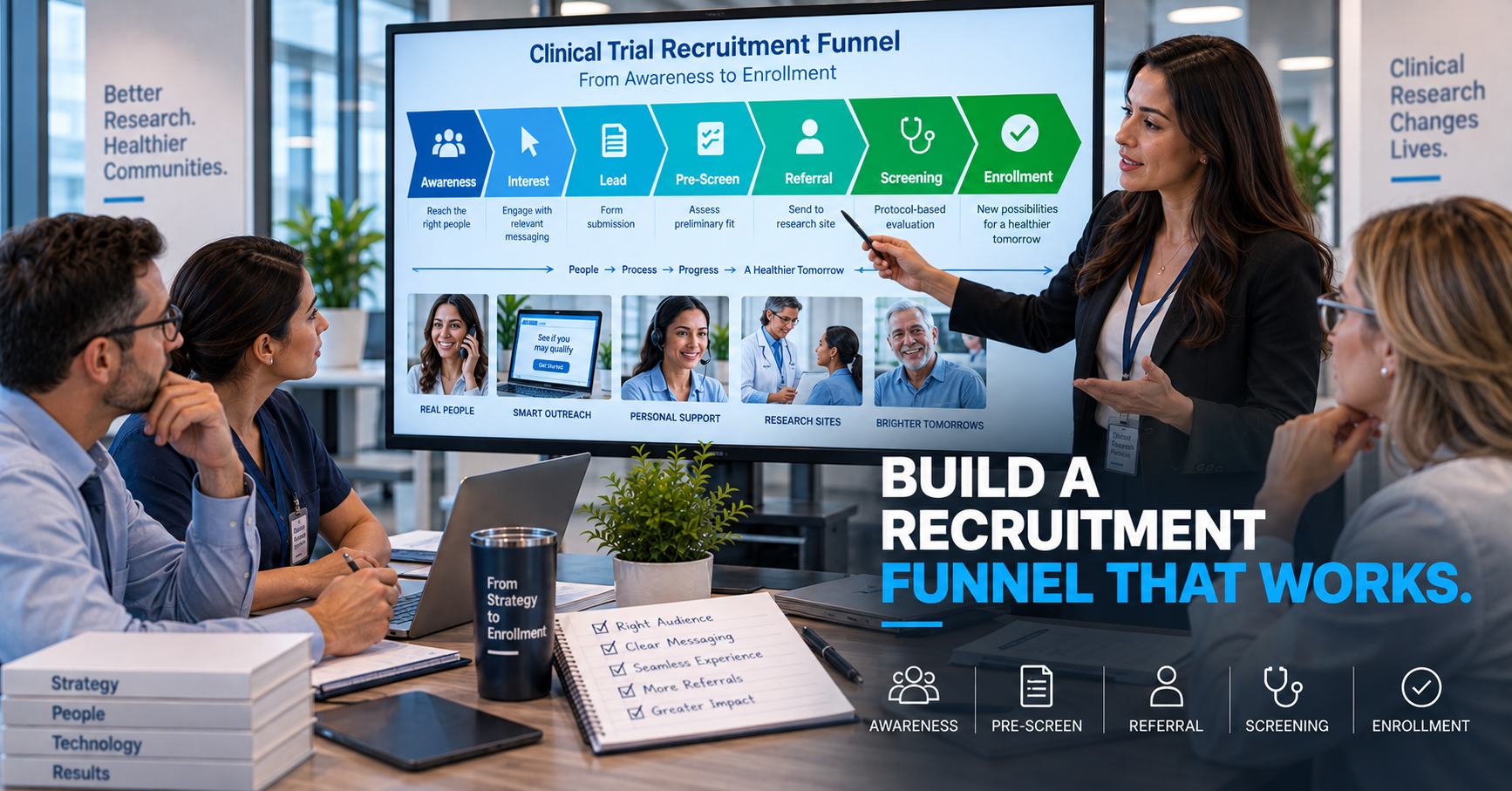
A clinical trial recruitment funnel is the structured pathway a prospective participant follows from first becoming aware of a Study to reaching appropriate Study screening and, eventually, enrollment. A practical funnel usually includes stages such as:
Awareness → Interest → Lead / Inquiry → Preliminary Pre-Screening → Human Review / Follow-Up → Referral → Site Screening → Enrollment
Each stage has a different purpose. The goal is not merely to move people downward as fast as possible. The goal is to move the right people through the process with enough clarity, trust, and operational support.
Why Research Sites Need a Funnel
Without a funnel, recruitment often becomes reactive. Ads are launched without a follow-up workflow. Leads arrive with no clear routing. Participants abandon forms without reminders. Sites receive raw inquiries without context. Marketing reports CPL while the Site struggles with screening volume. No one knows where people are being lost.
A funnel solves that by turning recruitment into a measurable system. It allows the organization to ask: are we reaching enough people? Are they interested enough to respond? Are they completing pre-screening? Are referrals getting to the correct Site? Is the Site converting referrals into screening? Where is the bottleneck?
The Funnel Is Not the Same as an Advertising Campaign
This distinction matters. An ad campaign usually measures impressions, clicks, Cost Per Click, leads, and Cost Per Lead. A recruitment funnel measures much more — contact rate, pre-screen completion, referral volume, referral quality, screening rate, and enrollment. The ad campaign lives at the top of the funnel. The recruitment funnel includes the entire journey.
Stage 1: Awareness
This is where the participant first encounters the opportunity. Awareness may come from Meta Ads, Google Ads, YouTube, Study websites, patient databases, community outreach, physician referrals, email, SMS, or word-of-mouth. The goal at this stage is not to explain the entire Study. The goal is to make the right audience aware that the opportunity exists.
Key questions at this stage: who needs to see this Study? In which geography? In which language? Through which channels? What message will capture attention appropriately? Common mistakes include targeting too broadly, unclear Study relevance, weak visual credibility, using generic healthcare messaging, ignoring geography, and treating English and Spanish audiences identically.
Stage 2: Interest
Awareness alone is not enough. The participant needs a reason to engage. Interest is created by relevant messaging, understandable language, credible visual presentation, clear Study context, and an appropriate call to action.
At this stage, the participant decides “should I learn more?” The message should help them understand what the Study generally concerns, whether it may be relevant, and what the next step is. Common calls to action include “Learn More,” “See if You May Qualify,” “Register to Learn More,” and “Complete a Brief Form.” Mistakes at this stage include language that sounds too sales-driven, overpromising, creating false certainty, and making the next step unclear.
Stage 3: Lead / Inquiry
This is the participant’s first active action. A lead or inquiry may be generated when the person submits a form, enters contact information, starts registration, calls a Study number, or requests additional information. This is the transition from passive audience to active prospect.
A lead does not mean eligible participant, referral, screened participant, or enrolled participant. It means the person expressed interest. That is important — but only as the start of the deeper process. Funnel design principle: do not build the entire recruitment strategy around this one stage.
Stage 4: Registration Experience
Although often grouped with lead generation, registration deserves separate attention because it is the first direct experience the participant has with the organization. A good registration step should be simple, mobile-friendly, easy to understand, short enough to complete, and clear about what happens next.
Registration should answer: what is this for? Why are you asking this information? How long will it take? What happens after I submit? Common causes of drop-off include long forms, confusing wording, too many early questions, weak mobile design, no visible trust signals, and unclear consent or purpose.
Stage 5: Confirmation
This is one of the most overlooked steps in the funnel. After submission, participants should receive a clear acknowledgment. Without confirmation, they may wonder: did it work? Will anyone call me? Was this legitimate? Should I wait or do something else?
A simple confirmation can communicate that the information was received, what happens next, when to expect follow-up, and who may contact them. This stage improves continuity and trust.
Stage 6: Preliminary Pre-Screening
Now the funnel begins moving from interest toward relevance. Preliminary pre-screening is designed to collect limited information that helps determine whether further Study-related contact makes sense — age range, ZIP code or location, relevant diagnosis, caregiver relationship, language, broad treatment history, or contact preference.
Preliminary pre-screening does not determine final eligibility. It only helps identify whether the person appears appropriate for further evaluation. This stage matters because it helps reduce irrelevant referrals, unnecessary Site burden, participant confusion, and inefficient follow-up.
Stage 7: Human Review and Follow-Up
Not every participant response fits neatly into an automated rule. Some people need clarification. Some responses are incomplete. Some participants have questions. This is where human review becomes critical.
A strong funnel usually includes recruiter review, follow-up calls, clarification of answers, participant engagement, and next-step explanation. Human follow-up adds context, empathy, clarification, trust, and a better participant experience. Common mistakes include waiting too long, calling without context, repeating information unnecessarily, and failing to continue in the participant’s preferred language.
Stage 8: Referral
Once a participant has expressed interest, completed preliminary steps, and appears appropriate for deeper review, the next step is referral. A referral is the handoff from the recruitment system to the Research Site. A strong referral includes context such as name and contact information, source campaign, preliminary responses, language, date of registration, recruiter notes, and other workflow-relevant information.
A lead tells you interest exists. A referral tells you a more structured participant opportunity exists. That makes referral a much stronger unit of recruitment value.
Stage 9: Routing
In single-Site studies, this step may be simple. In multi-Site studies, it becomes operationally central. Participants may need to be routed by ZIP code, distance, Site territory, language, Site capacity, screening availability, or participant preference. A funnel is not complete if it generates referrals but cannot determine where they should go.
Stage 10: Site Screening
This is where formal Study screening begins. The Site now determines whether the person satisfies protocol-specific criteria, which may include medical history review, detailed eligibility review, medication review, investigator judgment, lab work, diagnostics, or other protocol procedures. This stage belongs to the Research Site and should not be confused with marketing or pre-screening.
Even though this is a Site function, the funnel should still track screenings scheduled, screenings completed, screen failures, progression, and conversion from referral to screening. Without this feedback, earlier stages cannot be optimized effectively.
Stage 11: Enrollment
Enrollment is the ultimate downstream recruitment objective. This is where the funnel outcome becomes most meaningful. At this point, the organization can compare lead volume, referral volume, screening activity, and actual enrollment. That comparison is what reveals whether the funnel is working.
Funnel Design Starts Before the Ad
Many organizations begin by asking “which ad should we run?” A better starting point is “how should the participant move through the process?” Before launching a campaign, define who the target audience is, where they are, how they enter the funnel, what information they provide, how pre-screening works, who follows up, how referrals are routed, and how Site outcomes are reported back. Only then should the advertising layer be built around that structure.
Build the Funnel Backward From Enrollment
One practical method is to design the funnel starting from the bottom. Ask: what outcome are we trying to produce (enrollment)? What has to happen before enrollment (screening)? What information must the Site receive (referral)? Which high-level questions are necessary (pre-screen)? What first action do we want (lead)? Where will the audience come from (awareness)?
This approach prevents top-of-funnel activity from outrunning operational capacity.
Every Funnel Stage Should Have an Owner
A recruitment funnel becomes stronger when each stage has a clear operational owner. For example: awareness/interest belongs to the marketing team; registration/confirmation to marketing plus the automation workflow; pre-screening to the recruitment team or a structured system; human review to a recruitment coordinator; referral routing to central operations or a workflow system; screening to the Research Site; and enrollment reporting to the Research Site or centralized tracking.
Ownership reduces ambiguity. Without ownership, leads often sit untouched between teams.
Every Funnel Stage Should Have a Goal
A good funnel is not just a flowchart. Each stage should have a clear objective: awareness reaches the right audience, interest encourages relevant response, the lead captures interest, registration makes participation easy, confirmation reduces uncertainty, pre-screening identifies preliminary fit, human follow-up clarifies and builds trust, referral creates a useful handoff, screening assesses protocol eligibility, and enrollment converts appropriate participants.
When those objectives are defined, it becomes easier to diagnose underperformance.
Every Funnel Stage Should Have Metrics
A practical funnel should also have KPIs. Awareness metrics — impressions, reach, frequency. Interest metrics — CTR, CPC, video engagement. Lead metrics — leads, Cost Per Lead, form completion rate. Pre-screen metrics — pre-screen start rate, pre-screen completion rate, preliminary match rate. Referral metrics — referral volume, referral rate, Cost Per Referral. Site metrics — referral-to-screening rate, screening attendance, screen failure rate, enrollment volume, Cost Per Enrollment.
These metrics help identify exactly where the funnel weakens.
A Simple Funnel Example
Imagine the following: 50,000 ad impressions, 1,500 clicks, 220 leads, 180 completed registrations, 130 completed pre-screens, 62 potential referrals, 50 referrals sent to Site, 21 screenings completed, and 8 enrollments.
This funnel tells a story. It allows the organization to ask: is the ad attracting the right people? Is the form too long? Is pre-screening too strict? Is the Site following up fast enough? Is referral quality strong enough? Is the drop between referral and screening too high? That is much more actionable than simply saying “we generated 220 leads.”
Common Funnel Bottlenecks
Most recruitment funnels do not fail everywhere. They fail at specific points: weak response (the ad does not generate enough interest), form abandonment (people click but do not complete registration), pre-screen drop-off (the questionnaire is too long or unclear), slow follow-up (people lose interest before human contact), weak referral quality (too many preliminary mismatches), poor Site handoff (referrals arrive without enough context), and low referral-to-screening conversion (the Site is unable to move referrals forward efficiently).
Each bottleneck requires a different solution.
Do Not Overbuild the Funnel
Some teams respond to recruitment complexity by creating a funnel that is too heavy — too many questions, too many automation steps, too many decision points, too many approvals, too many handoffs. A funnel should create structure, not bureaucracy. The participant experience should still feel smooth.
Do Not Underbuild the Funnel Either
The opposite problem is also common: an ad goes live, a form collects name and phone, a spreadsheet receives the lead, and there’s no confirmation, no pre-screen, no routing logic, and no status tracking. This may be fast to launch. It is usually weak as a long-term recruitment system.
Single-Site and Multi-Site Funnels Are Not Identical
A single-Site Study may use a simpler funnel. A multi-Site Study may need centralized intake, geographic routing, Site capacity awareness, Site-level reporting, centralized dashboards, and budget allocation by performance. The funnel structure is similar, but the operational design becomes more complex.
Bilingual Funnels Need Full Continuity
A bilingual campaign requires more than a translated ad. The funnel should also support Spanish registration, Spanish confirmations, Spanish pre-screening, bilingual human follow-up, and Spanish-friendly routing or Site capability when relevant. If the participant enters the funnel in Spanish and then meets an English-only process, continuity breaks.
Technology Should Support the Funnel
Useful technology may include a CRM, lead forms, landing pages, marketing automation, SMS tools, email tools, routing systems, dashboards, AI-assisted organization, and reporting systems. But technology should support the funnel — not define it by itself. The organization should first decide how the recruitment process should work, then select the tools that help deliver it.
The Funnel Should Create Feedback Loops
One of the biggest benefits of a recruitment funnel is feedback. A well-connected system allows downstream outcomes to improve upstream strategy. For example: high CPL but strong referrals means keep testing before pausing; low pre-screen completion means simplify the form; strong referrals but weak screening means review the Site handoff; one geography producing better enrollments means shift budget; and a Spanish campaign with stronger referrals means expand bilingual support.
Without a funnel, these patterns remain hidden.
Build the Funnel for People, Not Just Data
A funnel is not only a reporting structure. It is also a participant journey. That means it should be designed for clarity, trust, simplicity, responsiveness, and continuity. A participant should never feel that they are falling from one disconnected system into another. The strongest funnels feel organized from the participant’s perspective as well as the organization’s.
A Practical Funnel Blueprint
If a Research Site or recruitment partner wants a simple working structure, here is a recommended blueprint:
- Define target audience and geography.
- Choose acquisition channels.
- Create clear participant-facing messaging.
- Build a short, mobile-friendly registration path.
- Set automatic confirmation.
- Implement preliminary pre-screening questions.
- Assign human review and follow-up rules.
- Define referral criteria.
- Set routing logic.
- Track Site screening outcomes.
- Measure funnel conversion by stage.
- Optimize based on downstream results.
That is a real recruitment funnel.
The Best Funnel Is the One the Site Can Actually Operate
An elegant funnel on paper means little if the Site cannot support it. The real funnel should match staffing, Study volume, Site capacity, technology, language needs, and operational maturity. A smaller Site may need a simpler funnel. A CRO managing multiple Sites may need a much more structured one.
From Clicks to Enrollments
The core purpose of a clinical trial recruitment funnel is to connect marketing activity with real Study progression. That is what transforms recruitment from campaign activity into operational performance.
Instead of treating recruitment as isolated parts, the funnel connects:
Awareness → Interest → Lead → Pre-Screening → Follow-Up → Referral → Screening → Enrollment
That is how a Research Site or CRO turns recruitment into a system that can be measured, improved, and scaled.
Related Reading
- Clinical Trial Patient Recruitment: From Advertising Clicks to Real Participant Opportunities
- From Lead Generation to Preliminary Pre-Screening: The Evolution of Clinical Research Recruitment
- The Metrics That Actually Matter in Clinical Trial Recruitment Campaigns
- Lead Generation vs Participant Recruitment: Why the Difference Matters
- What Is a Pre-Screened Participant Referral?
- Geographic Targeting for Clinical Trial Recruitment: How Far Should a Campaign Reach?
- Preparing Recruitment Materials for IRB Review: A Practical Guide for Marketing Teams
- How to Measure Recruitment Performance by Research Site
Frequently Asked Questions
What is a clinical trial recruitment funnel?
It is the structured process that moves a prospective participant from initial awareness of a Study to inquiry, pre-screening, referral, Site screening, and enrollment.
Is a clinical trial recruitment funnel the same as lead generation?
No. Lead generation is only one stage near the top of the funnel. The full funnel includes follow-up, pre-screening, referrals, screening, and enrollment.
What are the main stages of a recruitment funnel?
A practical funnel often includes awareness, interest, lead, registration, confirmation, pre-screening, human follow-up, referral, Site screening, and enrollment.
Why is pre-screening important in a recruitment funnel?
Pre-screening helps identify whether a participant appears appropriate for further contact before the Research Site invests deeper screening effort.
What should Research Sites measure in a recruitment funnel?
Sites should measure both top-of-funnel and downstream metrics, including leads, form completion, pre-screen completion, referrals, screening rate, and enrollment.