
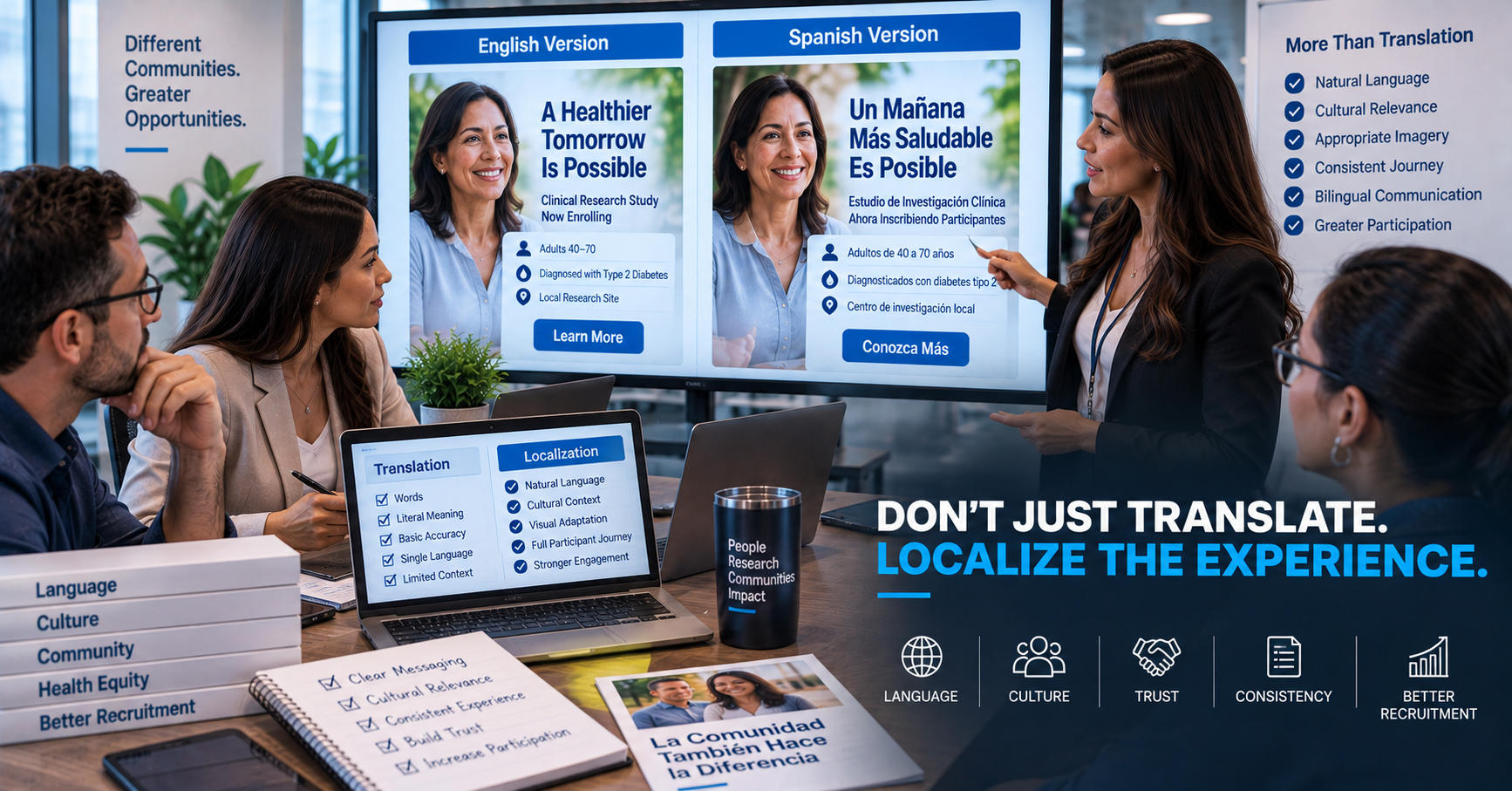
A clinical research organization creates an English recruitment campaign. The copy is approved. The design looks professional. The campaign performs well. Now the Site wants to reach Spanish-speaking participants.
The simplest approach is to translate the words. But that does not necessarily create an effective Spanish recruitment campaign. Translation answers “what do these words mean in another language?” Localization asks a broader question: “how should this message be communicated naturally and appropriately to this audience?”
That difference can affect comprehension, trust, response, form completion, participant engagement, and downstream recruitment. In clinical research, where people are already being asked to consider an unfamiliar and potentially sensitive opportunity, that difference matters.
Translation Is Only One Layer
Translation converts language. For example, “Clinical Research Study Now Enrolling” might become “Estudio de investigación clínica actualmente reclutando participantes.” Technically, the meaning may be correct.
But good recruitment communication needs more than semantic accuracy. It also needs to consider tone, natural phrasing, reading level, cultural context, terminology, visuals, participant expectations, and what happens after someone responds. That is localization.
Localization Starts Before Translation
One of the most useful lessons comes from the Spanish adaptation of ResearchMatch. Researchers did not begin by translating the existing English platform word for word. They first simplified the English content, removed jargon, lowered reading complexity, used plain language, then obtained professional Spanish translation, and finally involved bilingual community reviewers from diverse Hispanic backgrounds.
That sequence is important. If the English source material is confusing, too technical, overly formal, or unnecessarily long, translation simply reproduces those problems. A better process is:
Clarify → Simplify → Translate → Localize → Review
Plain Language Should Come First
Clinical research already contains complex terminology — investigational product, randomization, placebo, inclusion criteria, exclusion criteria, washout period, adverse events, screening visit. Participants do not need to think like researchers.
OHRP guidance emphasizes that research information should be presented in language understandable to the target population and that ordinary language should replace technical terminology whenever possible. That principle applies well before informed consent. Recruitment advertising should also be understandable, readable, and appropriate for the intended population.
A Literal Translation Can Be Correct and Still Be Weak
Literal translation often preserves English sentence structure. The result may be grammatically correct but unnatural. For example, “see if you may qualify” can be translated literally in ways that sound awkward or overly promotional. A more natural recruitment-oriented message may be “Conozca si este estudio podría ser una opción para usted.”
The exact wording depends on the Study, IRB-approved language, audience, geography, and context. The principle is more important than the specific phrase: translate meaning, not word order.
Localization Requires Cultural Context
Culture influences how people interpret communication. That does not mean stereotyping. Localization is not adding flags, inserting clichés, choosing stereotypical family imagery, or forcing regional slang. It is about understanding how the audience prefers to receive information, what builds credibility, who influences participation decisions, how formal the tone should be, and how research itself may be perceived.
Spanish-Speaking Audiences Are Not One Market
The United States includes Spanish-speaking populations with roots in Mexico, Cuba, Puerto Rico, the Dominican Republic, Central America, South America, Spain, and other regions. Vocabulary differs. Tone differs. Some words are understood everywhere but may feel more natural in one region than another.
ResearchMatch specifically recognized these linguistic and cultural differences when developing its Spanish version and used bilingual community reviewers from varied Hispanic backgrounds. This does not mean every Study needs ten Spanish versions. It means the safest approach is usually clear, broadly understandable Spanish with minimal unnecessary regional slang.
Localization Includes the Visual Design
Language changes layout. Spanish text is often longer than the English equivalent, which affects headlines, buttons, captions, subtitles, mobile forms, videos, and landing pages. A design created tightly around short English copy may break when Spanish text is inserted. Localization therefore needs design flexibility. The Spanish version should look intentional, not squeezed into an English template.
Video Localization Requires More Than Dubbing
Video deserves special attention. Imagine an English recruitment video with an English physician, English signs, English on-screen text, English subtitles, and an English CTA. Replacing only the audio with Spanish may produce a technically translated video. It may not feel localized.
Depending on the campaign, stronger localization may involve a Spanish-speaking presenter, Spanish captions, localized on-screen text, adjusted pacing, redesigned graphics, or different examples. The final video should feel as though it was created for the Spanish-speaking audience, not merely converted for them.
Calls to Action Should Be Localized Too
Calls to action often expose weak translation. Examples in English include “Learn More,” “See If You Qualify,” “Sign Up,” “Get Started,” and “Apply Now.” These phrases carry different tones. Some translations may sound too commercial, too strong, too casual, or too definitive for clinical research.
A localized CTA should reflect what actually happens next. For example, “learn more about the Study” is conceptually different from “apply now.” Recruitment messaging should match the participant journey.
Translation and Eligibility Language Require Extra Care
Clinical trial advertisements often include criteria such as age range, diagnosis, caregiver status, location, and prior treatment. A poor translation can unintentionally change meaning, creating irrelevant leads, participant confusion, and Site burden.
Eligibility language should therefore be reviewed by someone who understands both language and Study context. A fluent translator who does not understand clinical research can miss important nuances. A clinical expert who is not fluent may miss linguistic problems. The best workflow often combines both.
Bilingual Review Should Include More Than One Person
For important recruitment campaigns, relying on one bilingual employee can be risky. People have regional preferences, personal habits, and different levels of clinical terminology. A stronger review can involve professional translation, bilingual clinical/research review, participant-facing readability review, and community or native-speaker review when appropriate. ResearchMatch used this type of iterative process rather than relying on a single translation pass.
The Participant Journey Must Stay in the Same Language
Localization does not end with the advertisement. A participant may move through:
Spanish Ad → Spanish Landing Page → Spanish Form → Spanish Confirmation → Spanish Follow-Up → Spanish Site Communication
If the process becomes English-only halfway through, the experience breaks. This is one of the most important distinctions between translated advertising and bilingual recruitment.
Advertising in Spanish Creates an Operational Promise
When an organization advertises in Spanish, it communicates something implicitly: “we can interact with you in Spanish.” If that is not true after the lead is generated, trust can fall quickly.
The organization should know before launch: who follows up? Is Spanish-speaking staff available? Are scripts ready? Are forms localized? Can the Site continue communication in Spanish? Marketing should not create accessibility that operations cannot support.
Localization Also Applies to Confirmation Messages
Consider this experience: a Spanish advertisement, a Spanish form, and then “Thank you for your submission. Our recruitment coordinator will contact you shortly.” The participant can probably understand it. But the language continuity is gone immediately. Confirmation messages are part of the recruitment experience. They should be localized too.
SMS and Email Need the Same Attention
Automated communication often gets forgotten. The campaign may localize ads, the landing page, and the form, but not SMS reminders, email confirmations, missed-call messages, or appointment reminders. That produces an inconsistent journey. A complete localization inventory should include every participant-facing touchpoint.
Localization Can Affect Trust
People notice when communication feels natural. They also notice when it feels machine-translated. In clinical research, that matters because the audience may already be asking: is this real? Is this safe? Who is contacting me? Will I understand what happens? Natural language reduces unnecessary uncertainty. Localization is therefore not just stylistic — it can support trust.
Trust Is Especially Important in Clinical Research
A person responding to an advertisement is not buying a consumer product. They may be considering sharing health information, talking about a medical condition, visiting an unfamiliar Site, or participating in research. That creates a higher trust requirement, and language quality becomes part of credibility.
Cultural Relevance Does Not Mean Cultural Assumptions
Marketing teams should avoid oversimplification. Not every Hispanic participant makes decisions through family, prefers the same tone, responds to the same imagery, or shares the same cultural values. Localization should improve relevance without reducing people to stereotypes. Use audience understanding, not assumptions.
Caregiver Studies Require Special Attention
For certain Studies, the person seeing the advertisement may not be the participant — pediatric Studies, Alzheimer’s disease, dementia, and some neurological Studies are common examples. In these situations, localization should ask who is really making the first recruitment decision: a parent, spouse, adult child, or caregiver? The message may need to speak directly to that person.
Geography Can Influence Spanish Localization
Spanish recruitment in South Florida may involve different linguistic expectations from campaigns in California, Texas, New York, or Arizona. Again, this does not always require separate versions, but geography should inform review. For example, in Miami, Cuban and broader Caribbean Spanish influences may be more common; in Southern California, Mexican Spanish may dominate. Neutral language may work nationally. Local adaptation may improve specific campaigns.
Localization Should Be Measured
Do not assume the localized campaign performs better simply because it sounds better. Measure it. Useful acquisition metrics include CTR, CPL, and form completion. Useful recruitment metrics include pre-screen completion, referral rate, Cost Per Referral, screening, and enrollment. Useful participant-experience metrics include contact rate, abandonment, language mismatch, and communication issues. The goal is not just better Spanish — it is better recruitment.
Measure English and Spanish Separately
If English and Spanish campaigns are merged into one report, operational problems can remain hidden. For example, English might show strong lead volume with a moderate referral rate, while Spanish shows a higher CPL but a stronger referral rate. If only blended CPL is reported, the stronger downstream value of Spanish recruitment may disappear. Language should be treated as a meaningful performance dimension.
Localization Can Improve Form Completion
Forms should be tested in each language. Check question length, button labels, mobile layout, terminology, and error messages. A form designed for English may need layout changes in Spanish. Do not assume translation preserves usability.
Localization and IRB Review Need Coordination
Participant-facing recruitment materials may require IRB review, which means language versions should be planned early. A common inefficient sequence is: English gets approved, the campaign launches, Spanish is requested, translation begins, Spanish materials require separate review, and campaign expansion is delayed. A stronger strategy is to plan both languages together whenever practical.
Version Control Matters
Bilingual campaigns double the number of files — EN static ad, ES static ad, EN video, ES video, EN form, ES form, EN SMS, ES SMS. Every version should be traceable. The English V2.0 and Spanish V1.2 may no longer be equivalent. This is why bilingual recruitment needs disciplined version control.
Do Not Let AI Translation Be the Final Review
AI translation can be useful. It can accelerate first drafts, terminology comparison, alternative wording, and localization workflows. But participant-facing research materials should not rely blindly on automated translation. AI can produce language that is grammatically correct, contextually wrong, overly literal, or inconsistent with Study terminology. Use AI as support, not as the final authority.
Create a Localization Workflow
A practical process may look like this: Step 1 — Simplify English (remove unnecessary complexity). Step 2 — Translate Professionally (create accurate initial language). Step 3 — Clinical Review (confirm Study meaning). Step 4 — Localization Review (check naturalness and cultural relevance). Step 5 — Layout Review (ensure design works). Step 6 — Participant Journey Review (check the ad, form, SMS, calls, and Site communication). Step 7 — IRB Workflow (submit required materials appropriately). Step 8 — Performance Review (measure the localized campaign separately).
A Practical Localization Checklist
Before launching a bilingual recruitment campaign, ask: does the language sound natural, and is the reading level appropriate with jargon minimized? Does the meaning match the Study, with eligibility concepts preserved? Does the message fit the audience without relying on stereotypes? Does the Spanish copy fit the design, with readable subtitles? Are confirmation messages localized, with bilingual follow-up available? Can performance be measured separately by language? Are the correct versions approved and tracked?
If several answers are no, the campaign is probably translated — but not localized.
Translation Changes Words. Localization Changes Experience.
This is the essential distinction. Translation asks “what should this sentence say in Spanish?” Localization asks “how should this entire recruitment experience work for someone who prefers Spanish?” That includes words, tone, visuals, forms, videos, communication, staff, follow-up, and measurement.
Clinical research organizations that understand this distinction can build bilingual recruitment systems that feel intentional rather than improvised.
The Goal Is Not Spanish Advertising
The goal is Spanish participant recruitment. That requires more than turning an English ad into a Spanish ad. It requires an English recruitment journey and a Spanish recruitment journey, both capable of moving participants appropriately toward the Research Site. That is why localization matters.
Related Reading
- English vs Spanish Clinical Trial Campaigns: Why Translation Alone Is Not Enough
- IRB Review and Clinical Trial Advertising: What Marketing Teams Should Understand
- Clinical Research Recruitment Videos: Human Presenter, Voice-Over or AI Avatar?
- Why Participant Experience Matters Before the First Research Site Call
- Preparing Recruitment Materials for IRB Review: A Practical Guide for Marketing Teams
Frequently Asked Questions
What is the difference between translation and localization?
Translation converts content from one language to another. Localization adapts language, tone, design, terminology, and participant experience for the intended audience.
Why is localization important in clinical trial recruitment?
Clinical research involves complex information and high trust requirements. Natural, understandable, audience-appropriate communication can reduce confusion and improve recruitment continuity.
Should Spanish recruitment materials use literal translations?
Not necessarily. Literal translation can preserve meaning but still sound unnatural or unclear. Participant-facing language should communicate the intended meaning naturally and accurately.
Does localization include more than advertising?
Yes. Forms, landing pages, confirmations, SMS, emails, pre-screening, human follow-up, and Site communication should all support the participant’s language when the organization is recruiting that population.
Can AI be used to translate clinical trial advertising?
AI can assist translation workflows, but participant-facing materials should receive appropriate human and Study-specific review before use.