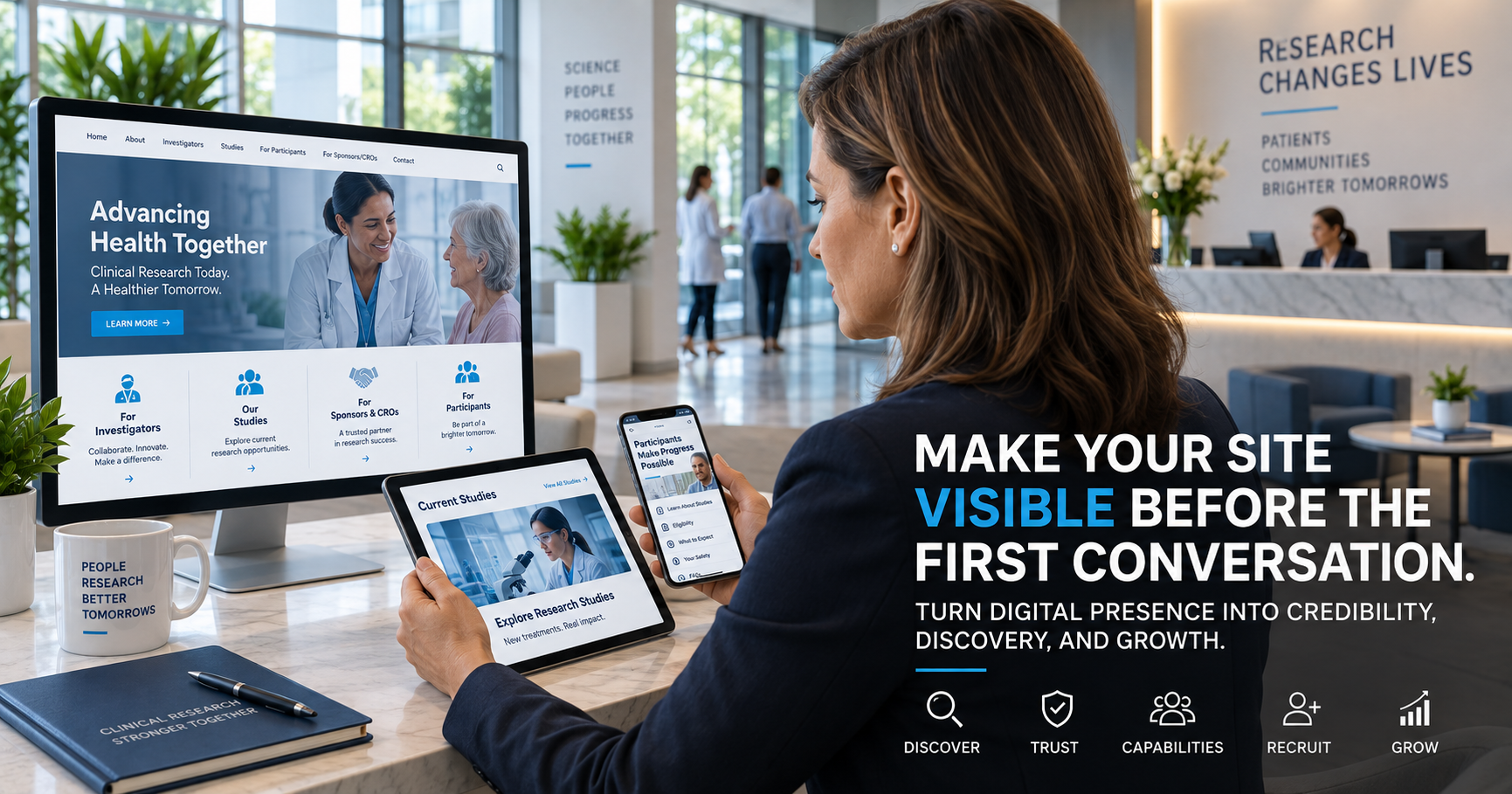
A Clinical Research Site can have excellent investigators, experienced coordinators, strong recruitment capabilities, and reliable operations. But if someone searches for the organization online and finds an outdated website, incomplete investigator information, no clear therapeutic areas, no current Studies, poor mobile design, or no obvious way for a Sponsor or CRO to make contact, much of that capability remains invisible.
For an independent Research Site, digital presence is more than branding. It can influence participant trust, recruitment, Site credibility, business development, Sponsor/CRO discovery, investigator visibility, and long-term growth. The objective is not simply “have a professional website.” It is to make the Site’s real capabilities easy to understand online.
Your Digital Presence Serves More Than One Audience
A Research Site website is unusual because several very different audiences may visit it.
Prospective participants want to know which Studies are enrolling, whether the organization is legitimate, where the Site is, what happens if they respond, and whether someone can communicate with them in their preferred language. Sponsors and CROs may want to know which therapeutic areas the Site covers, who the investigators are, what patient population the Site can access, what recruitment capabilities exist, where the locations are, and who handles feasibility or business development. Investigators and healthcare professionals may be evaluating collaboration, research opportunities, and referral relationships. Employees and potential team members may be assessing organization, credibility, culture, and growth.
One generic homepage cannot answer every question equally well. The digital experience should intentionally support multiple paths.
A Site Website Has a B2C and B2B Function
This distinction is fundamental. On the B2C, participant-facing side, the website supports Study awareness, participant education, registration, recruitment, and trust. On the B2B, industry-facing side, it supports Site positioning, Sponsor/CRO visibility, business development, investigator presentation, and capabilities communication. A Site that builds only for participants may miss business-development value, while a Site built exclusively for Sponsors may be difficult for participants to understand. The strongest digital presence supports both.
Sponsors and CROs Care About Recruitment Capability
Digital presence should reflect what the industry actually values. A 2019 survey published in Trials analyzed 83 responses from decision-makers for trial site selection in the Nordic countries, employed at multinational biopharmaceutical companies and CROs. Among those respondents, 84% strongly agreed or agreed that recruitment-related factors are the site-related qualities their company values the most. In addition, 88% preferred reaching enrollment goals at trial sites in their region 10% quicker rather than cutting costs at all sites by 20%, and recruitment and retention track record was ranked first by 71% when respondents were asked which information about an unfamiliar trial site their company would find most valuable (Trials, 2019).
It is a regional survey, so it should be read as an indicator rather than a universal rule. But the implication for Site websites is direct: do not make recruitment capability invisible.
Show Capabilities, Not Just Mission Statements
Many Research Site websites open with statements such as “Advancing the Future of Medicine,” “Changing Lives Through Research,” or “Building a Healthier Tomorrow.” These statements can support brand identity, but they do not tell a CRO what the Site can actually do. Strong positioning should also communicate therapeutic areas, investigators, recruitment population, geographic reach, Site locations, language capabilities, infrastructure, Study phases, technology, and operational strengths. The mission statement creates emotion. Capabilities create credibility.
The Homepage Should Explain the Site Quickly
A visitor should be able to understand the organization within seconds. A strong opening section communicates who the organization is (an independent or networked Clinical Research Site), where it operates (city, state, region, or Site network), what it does (key therapeutic areas or Study capabilities), and who it serves (participants and industry partners). For example: “Independent Clinical Research Site supporting Phase II–IV Studies across metabolic, CNS, and gastroenterology indications, with bilingual participant recruitment and access to diverse South Florida populations.” That immediately creates context.
Build a Clear Participant Path
A prospective participant should not need to understand the Site’s corporate structure. They need a simple route: Find a Study → Learn About Participation → See Study Information → Register Interest → Understand What Happens Next. The website should reduce anxiety and confusion.
Show Currently Recruiting Studies Clearly
If appropriate for the Site’s workflow, active Study pages can become important recruitment assets. Each page may include the condition or research area, a general age range, the location, high-level Study information, appropriate participation requirements, and the next step. The language should remain participant-friendly. Avoid simply publishing the protocol title — participants search differently from researchers.
Mobile Experience Is Essential
Many prospective participants will encounter the Site through Meta Ads, Google, social media, SMS, or email, which often means a mobile phone. The website should work comfortably on small screens. Review font sizes, forms, buttons, menus, page speed, videos, and call-to-action placement. If the participant cannot comfortably complete the next step on a phone, marketing performance can suffer.
Keep Participant Forms Focused
The website does not need to perform full protocol screening. A participant-facing registration form may initially collect name, contact information, location, Study interest, preferred language, and selected preliminary questions. The purpose is to move someone appropriately into the recruitment workflow. Long forms can create unnecessary drop-off.
Explain What Happens After Registration
One of the easiest improvements is simply telling participants what comes next. Step 1: submit your interest. Step 2: our recruitment team reviews your information. Step 3: you may be contacted to discuss preliminary Study information. Step 4: the Research Site determines whether formal screening is appropriate. This provides context, and participant experience begins before the first Site call.
Make Contact Information Obvious
Do not hide the phone number, address, general email, or participant contact information. The Site should feel real and reachable. This matters particularly when participants arrive through paid social media and may never have heard of the organization before.
Establish Trust Signals
Trust can be supported by showing real information: real Site photographs, actual investigators, a physical address, staff, therapeutic expertise, professional affiliations where appropriate, and clear contact information. Avoid making the website look like a generic lead-generation page detached from an actual research organization.
Investigator Pages Matter
Investigators are one of the strongest credibility assets a Site has. Create clear profiles with appropriate information such as name, specialty, credentials, research experience, therapeutic expertise, and role at the Site. For participants, investigators create human credibility. For CROs and Sponsors, they help establish Study capability.
Build an Industry-Facing Path
Sponsors and CROs should have their own obvious destination. A navigation option such as “Sponsors & CROs” or “Industry Partners” can lead to a dedicated page that answers questions relevant to Site selection.
What Should an Industry Page Include?
Consider covering therapeutic areas (where does the Site have experience?), investigators (who can conduct Studies?), patient population (what populations can the Site realistically access?), recruitment infrastructure (how does the Site recruit?), geographic reach (where do participants come from?), language capabilities (is recruitment bilingual?), facilities (what does the Site offer?), Study experience (which phases and Study types?), and a business-development contact (who should Sponsors and CROs reach?). Do not make industry partners search the participant pages for this information.
Present Recruitment Capability as Infrastructure
A strong Site should be able to explain how recruitment works: its participant database, digital advertising, physician referrals, community outreach, bilingual campaigns, pre-screening, CRM, and rapid follow-up. This is valuable because recruitment capability is a major Site-selection consideration. The Site is not simply saying “We can recruit.” It is showing how.
Do Not Publish Unsupported Performance Claims
Avoid statements such as “#1 Research Site in Florida,” “Fastest Enrollment in the Industry,” or “Guaranteed Recruitment” unless there is an appropriate basis for the claim. Clinical research credibility benefits from evidence, not exaggeration. Instead, use verifiable capabilities.
Performance Data Can Strengthen Positioning
Where accurate and appropriate, Sites may communicate metrics such as Studies completed, therapeutic experience, participant database size, number of investigators, locations, and geographic coverage. Any metric should be current, truthful, and understandable. Do not create vanity statistics simply to fill space.
The Website Should Make Feasibility Contact Easy
Imagine a CRO is evaluating Sites for a new Study and finds the website. They should not need to call the general reception number and explain, “I’m trying to reach whoever handles clinical-trial feasibility.” Provide a Business Development / Feasibility contact with a clear path — an email, a form, a named contact, or a dedicated page. Reduce friction.
Business Development Forms Should Be Different From Participant Forms
A participant says “I’m interested in a Study.” A CRO says “I want to send a feasibility questionnaire.” These are completely different interactions, and they should not be routed through the same generic Contact Us form if avoidable. A business-development form might collect the organization, contact, therapeutic area, Study phase, a short description, and an attachment or contact request where appropriate. The Site can then route it internally.
Fast Response Matters Digitally Too
Digital presence is not only what someone sees. It is what happens after they contact the Site. A professional industry page loses value if feasibility inquiries sit unanswered for a week. Digital strategy needs operational ownership: Industry Inquiry → Business Development Owner → Acknowledgment → Follow-Up. The website should connect to a real process.
Search Visibility Matters
A professional website that nobody finds has limited value. Sites should consider organic search around realistic topics such as clinical research in their city, clinical trials in their city, Research Site in their state, Study-specific conditions, and Site therapeutic areas. The objective is not keyword stuffing. It is making relevant information discoverable.
Local SEO Matters for Research Sites
Physical Sites should maintain consistent business information — Site name, address, phone, hours, and website — across the website, the Google Business Profile where applicable, and relevant directories. Consistency helps participants find and verify the organization.
Content Can Build Authority
A Site website does not have to remain static. Useful content might address how clinical trials work, what participants can expect, Study-specific recruitment topics, therapeutic research, Site capabilities, and research education. For organizations targeting Sponsors and CROs, content can also demonstrate recruitment expertise, technology, operations, and therapeutic knowledge. This creates authority over time.
Keep Medical Education Separate From Marketing Claims
Clinical research websites need clear boundaries. Educational content should not imply diagnosis, treatment recommendation, or guaranteed Study benefit. The objective is to provide useful information while preserving appropriate research context.
Your Site Should Look Active
An outdated website creates an unfortunate signal: a last news post from 2019, Studies no longer recruiting, investigators who left years ago, broken forms, old phone numbers. Even if the Site itself is excellent, the digital presence suggests otherwise. Create a maintenance process.
Assign Website Ownership
Someone should own Study updates, investigator changes, contact information, recruitment pages, and business-development content. Without ownership, websites decay. A strong digital presence is an operating process, not a one-time design project.
Website Speed Matters
Participants may reach the Site from paid advertising, and every second of unnecessary loading creates friction. Heavy animations, oversized video, unoptimized images, and complicated scripts can slow the experience. The website should prioritize usability over decoration.
Accessibility Matters
A Clinical Research Site serves diverse populations, so digital accessibility should be part of design. Consider readable font size, contrast, keyboard accessibility, form labels, alt text, and understandable navigation. Accessibility improves usability for everyone.
Bilingual Sites Need Complete Language Paths
If the organization actively recruits Spanish-speaking participants, a Spanish website path may provide meaningful value. But again, translation is not localization. The Spanish-speaking participant should be able to move through Study information, registration, confirmation, and contact without the experience unexpectedly switching into English.
Site Photography Should Feel Real
Real photography can differentiate an independent Site significantly. Useful images include the facility, reception, research rooms, the actual team, and the investigators. Stock photography can support some design needs, but a website built entirely from generic physicians and laboratory imagery may look indistinguishable from hundreds of other organizations. Real environments create identity.
Your Digital Presence Includes More Than the Website
It also includes LinkedIn, Google presence, social channels, industry directories, investigator profiles, digital Study listings, and recruitment campaigns. The objective is consistency. If the website says “Site A,” LinkedIn says “Site A Research Center LLC,” and another directory lists an outdated location, credibility weakens.
LinkedIn Has a B2B Role
For Site business development, LinkedIn can support company updates, investigator introductions, new capabilities, Site expansion, industry networking, and conference participation. The objective is not simply follower count. It is maintaining professional visibility among CRO personnel, Sponsors, investigators, and industry partners.
Social Media Has a Participant Role Too
Facebook and Instagram may support Study recruitment, community education, Site visibility, and credibility. But social content should remain consistent with the organization’s clinical research positioning. The Site should not look like a general consumer brand selling healthcare services.
The Website Should Connect to Recruitment Technology
When appropriate, participant forms should flow into a CRM, a recruitment workflow, and appropriate routing. Avoid sending every website form to a general email inbox if recruitment volume is significant. A Site becomes more scalable when digital touchpoints connect to operational systems.
Analytics Should Measure More Than Traffic
Website analytics should answer useful questions. On the participant side: which Study pages receive traffic, which pages generate registrations, where users abandon forms, and how mobile behavior differs from desktop. On the industry side: which capabilities pages are viewed, whether feasibility forms are being completed, and which sources send B2B traffic. Traffic alone is not the objective. Conversion is.
Create Separate Conversion Goals
Different audiences require different measurements. Participant conversion is a Study registration. Industry conversion is a business-development inquiry. Other conversions include phone calls, Study page views, and contact requests.
Avoid Making the Website a Brochure
A brochure says “Here is who we are.” A useful digital platform says “Here is what you can do next.” For participants: find a Study. For Sponsors: send a feasibility opportunity. For physicians: contact the Site. For applicants: view careers. Every major audience needs an action.
Sponsor/CRO Credibility Comes From Operational Evidence
Digital presence alone will not make a Site competitive. A beautiful website cannot compensate for poor recruitment, weak data quality, slow startup, or operational problems. As the site-selection survey above suggests, Sponsor/CRO decision-makers place substantial value on recruitment-related capability and performance. The website should therefore reveal real operational strength rather than substitute for it.
Digital Presence Should Support Feasibility
Site selection increasingly involves structured, data-oriented workflows. Commercial site-selection platforms, for example, organize Site profiles, capabilities, workflows, and performance information to help Sponsors and CROs evaluate and engage potential Sites. That suggests a useful principle for independent Sites: make relevant Site information easy to discover before someone has to ask for it. The website cannot replace formal feasibility, but it can improve the first impression that precedes it.
Build the Website Around Questions
A practical approach is to ask what each audience needs to know. The participant asks, “What do I need to know before I raise my hand?” The CRO asks, “What do I need to know before I shortlist this Site?” The Sponsor asks, “What evidence suggests this organization can recruit and execute?” The investigator asks, “Why should I work with this Site?” Then build the digital architecture around those questions.
A Practical Website Structure
A practical structure includes: Home (clear Site positioning), Clinical Trials (current recruitment opportunities), For Participants (what participation involves), Investigators (profiles and expertise), Therapeutic Areas (research capabilities), Sponsors & CROs (industry-facing capabilities), Locations (geographic footprint), About (organization and team), and Contact (separate participant and industry paths). Optionally, add Insights / Blog for educational and authority-building content.
A Digital Presence Checklist
A strong Site should be able to answer yes to most of these questions.
- Identity: Is it immediately clear that this is a Clinical Research Site? Is the location obvious? Are therapeutic areas visible?
- Participants: Can someone find recruiting Studies? Is the next step clear? Does the Site look trustworthy? Does the form work well on mobile?
- Sponsors/CROs: Are investigators visible? Are capabilities clear? Is recruitment infrastructure explained? Is there a dedicated industry contact?
- Operations: Do forms route correctly? Are responses assigned to someone? Are outdated Studies removed?
- Technology: Is the site fast? Is analytics installed? Can recruitment sources be measured?
- Language: Are bilingual journeys complete where needed?
- Credibility: Are claims factual? Is information current? Does the organization look active?
Digital Presence Is an Organizational Asset
Paid advertising stops when the budget stops. A strong digital presence remains. Over time, it can support participants discovering the Site, CROs evaluating capabilities, Sponsors recognizing the organization, investigators considering collaboration, and community partners finding contact information. That makes the website more than marketing collateral. It becomes part of Site infrastructure.
The Real Goal Is Discoverability + Credibility + Action
A strong digital presence should achieve three things. Discoverability: people can find the Site. Credibility: they understand why the organization is legitimate and capable. Action: they know what to do next — learn about a Study if they are a participant, send an opportunity if they are a CRO, evaluate capabilities if they are a Sponsor. That is how digital presence supports growth.
Related Reading
- What Is Clinical Research Marketing? A Practical Guide for Research Sites and CROs
- How to Grow an Independent Clinical Research Site
- What Should a Clinical Research Site Look for in a Recruitment Marketing Partner?
- How to Build a Clinical Trial Recruitment Funnel
- CRM for Clinical Trial Recruitment: What Research Sites Actually Need
Frequently Asked Questions
Why does a Clinical Research Site need a strong website?
A website supports participant recruitment, organizational credibility, investigator visibility, and business development with Sponsors and CROs.
What should a Research Site website include for Sponsors and CROs?
Useful information includes therapeutic areas, investigators, Site locations, patient population, recruitment capabilities, operational infrastructure, and a clear business-development contact.
Should recruiting Studies appear on the Site website?
When appropriate, yes. Current Study pages can support participant discovery and recruitment, provided participant-facing information follows the Study’s applicable recruitment and IRB requirements.
Is a Research Site website mainly for patients?
No. Research Site websites usually serve both participant-facing and B2B audiences, including CROs and Sponsors.
Can a professional website help a Site win more Studies?
A website alone cannot replace Site performance, but it can make capabilities, investigators, recruitment infrastructure, and business-development contacts easier for industry partners to discover and evaluate.